
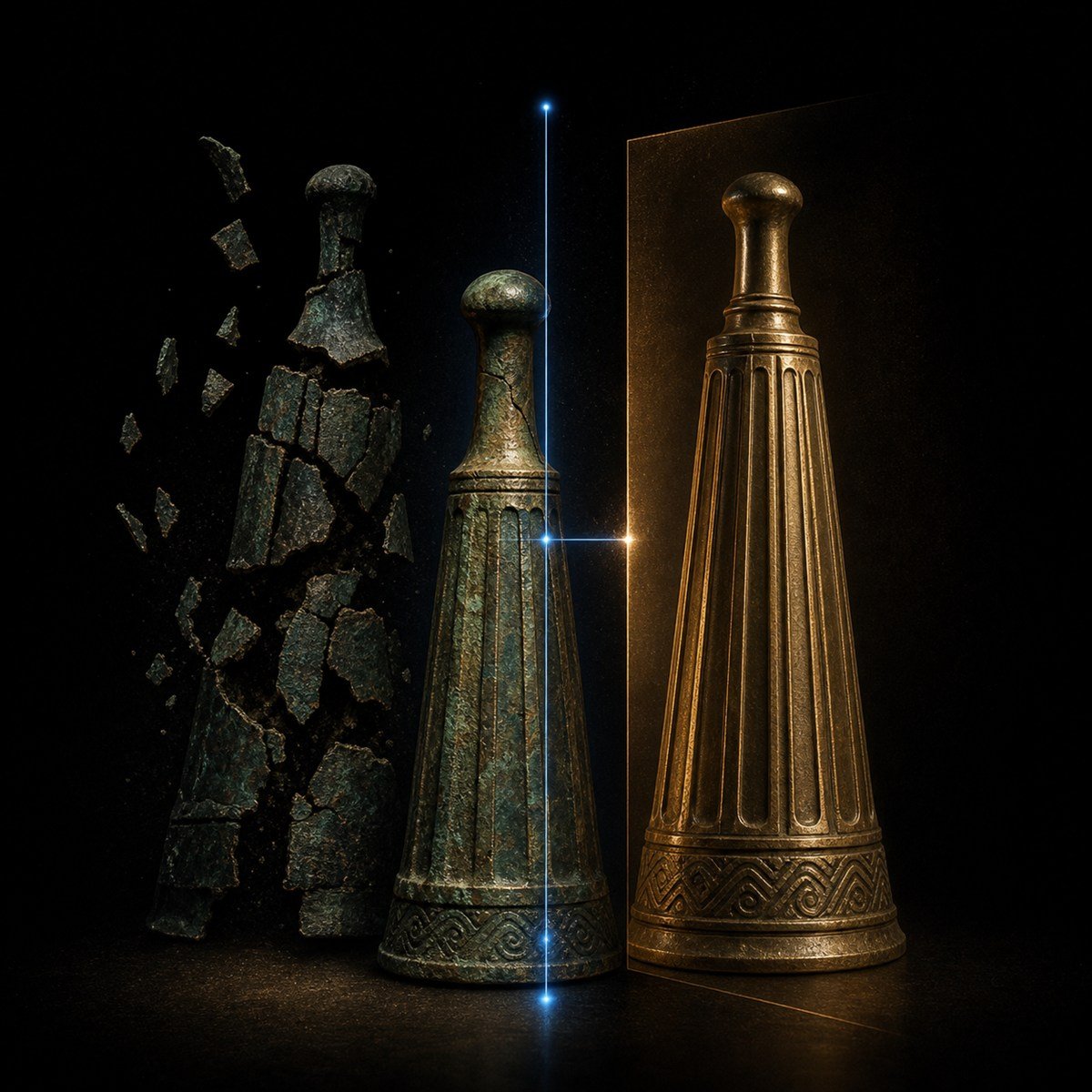
When ROI Is Highest
The best candidates for pre-sale restoration are high-estimate objects, typically from around £10,000 upward, where presentation quality materially affects buyer confidence; objects with active corrosion that depresses value but can be stabilized at a reasonable cost; and objects with limited losses, such as a cheekpiece or nasal guard, where reconstruction significantly improves visual coherence.
When Restoration Does Not Pay Back
Small objects with low estimates, for example below £2,000, may cost more to treat than the likely increase in value. Objects with a severely destroyed metal structure may require more new material than original material, reducing collecting value. And if no serious auction house will accept an object because of provenance or legal concerns, restoration does not solve that problem.
Restoration Does Not Create Value on Its Own
The value of an ancient object is determined by a combination of factors: authenticity, rarity, provenance, type, preservation, surface quality, demand and the sales venue. Restoration can improve legibility and reduce risk, but it cannot turn a weak object into a rare one and cannot guarantee a particular price.
The calculation should therefore begin not with an attractive ‘before and after’ difference, but with several scenarios. What happens if the object is sold as is, after minimal stabilization, or after more extensive reconstruction? What costs, timeframes and new risks are associated with each option?
Four Types of Value
Historical, material, visual and market value should be considered separately. Preserving an original surface may matter more than achieving a perfect silhouette. On another object, recovering geometry may dramatically improve understanding. Market benefit appears only when professional intervention strengthens the object's existing qualities without destroying evidence of age.
A decision cannot be judged by one number. Sometimes treatment is commercially justified, sometimes it is justified only by preservation, and sometimes the best result is to decline active restoration.
Scenario: Sell As Is
This is reasonable when the object is stable, losses are understandable and intervention would be expensive or speculative. Some collectors prefer archaeological fragmentation. On a research object, visible evidence of condition may be more valuable than visual completeness.
But ‘as is’ does not mean ignoring active corrosion or an unsafe structure. Minimal stabilization and a safe support may be necessary regardless of commercial strategy.
Scenario: Minimal Intervention
The task is limited to what affects safety and legibility: stabilize an active focus, secure a weak fragment, remove visually dominant contamination and provide support. This approach preserves both budget and the maximum amount of original material.
It is particularly appropriate when full reconstruction would require substantial assumptions. The buyer sees an honest condition, while the future owner retains freedom to make further decisions.
Scenario: Reconstruction of Form
Reconstruction is justified when surviving lines provide sufficient evidence and restoring geometry materially changes how the object is understood. For a helmet, vessel or weapon, silhouette can be central. New structure, however, must not overload mineralized original edges.
The budget includes not only joining but diagnosis, temporary fixing, internal reinforcement, surface integration, monitoring and packing. An unrealistically low quotation often excludes these less visible stages.
The Net-Result Formula
It is more useful to calculate a range than a maximum possible price. Subtract commission, taxes, transport, insurance, research, restoration and the cost of time from the expected proceeds. Then compare conservative, middle and optimistic scenarios.
If a project only makes sense under a record sale, it is high risk. If minimal stabilization makes the object safer and easier to understand even in the low scenario, the decision is more robust.
When Expensive Restoration Does Not Pay
Treatment does not pay when its cost exceeds the likely difference in value, when it depends on an overly ambitious attribution, or when it requires a large proportion of invented form. A project with a hard deadline that leaves no time to observe stability is also risky.
Declining a commission can be a professional outcome. An honest assessment saves the owner money and protects the object from unnecessary intervention.
When Intervention Changes the Commercial Outlook
The effect is most visible when a rare object becomes difficult to read because of remediable fragmentation, an unstable old repair or local active corrosion. Restoring a safe form helps both specialists and buyers understand the object. But this effect cannot responsibly be converted in advance into a guaranteed percentage increase in price.
Public results from previous lots demonstrate the studio's experience; they do not predict a new result. Every object and every auction day is different.
The Role of Documentation
A simple set is sufficient: initial condition record, agreed scope, photographs of key stages and a final treatment note. Grand ‘official protocols’ are unnecessary if the studio is not authorized to issue the type of certification implied.
The document describes the work performed and recommendations. Attribution, authenticity, insurance valuation and lot acceptance remain the responsibility of the relevant specialists.
Risks in Preparing for Sale
Over-cleaning can remove historical surface. An overly rigid reconstruction can transfer load into original material. Concealment can reduce confidence. Rushed packing can destroy the result during transport. These risks belong in the commercial calculation alongside the price of the work.
A good plan therefore contains a stopping point and an alternative. The owner knows in advance what will happen if the physical condition proves worse than the preliminary assessment suggested.
How to Discuss the Budget
Start with the objective: storage, display, transfer, sale or research. Then separate necessary actions from desired presentation. This is more useful than asking ‘how much to restore it completely?’ because complete intervention is not always necessary.
The minimum cost of work is €300. The basic cycle includes intake, inspection, preparation of a safe work area, materials, photographic documentation and a final record. The final budget is confirmed after physical inspection.
Logistics and Geography
Transfer through partners in Brussels and London can simplify the route for European and UK clients. It is not an automatic scheme: packing, documents, insurance and customs questions are agreed for each object before dispatch.
Logistics cost belongs in the overall result model. The cheapest route is not always the safest, and the most expensive route does not replace a properly designed support.
Conclusion: The Decision Should Still Make Sense in a Weak Scenario
A financially mature decision does not depend on one record price. It preserves the object, reduces uncertainty and leaves the owner with a clear choice. Sometimes that means reconstruction, sometimes local stabilization, and sometimes sale without intervention.
For a preliminary discussion, send photographs, dimensions, known intervention history and the intended objective. The response will help identify what additional information is needed and whether a physical inspection makes sense.
Practical Scenarios for an Economic Decision
These scenarios demonstrate the decision-making principle. No specific auction or sales outcome is guaranteed.
1. A Low-Value Object with Active Deterioration
Initial situation.The cost of full reconstruction is comparable to the optimistic sale price.
Risk and decision.Commercially, minimal stabilization or declining the purchase may be more reasonable unless preservation itself is the owner's goal.
Practical conclusion.The calculation should use net result and risk, not the difference between two attractive headline estimates.
2. A Rare Helmet with Repairable Fragmentation
Initial situation.The type and surface are strong, but the form is difficult to read because of an old weak assembly.
Risk and decision.A justified reconstruction can reveal the quality of the object, but the budget must include monitoring and support.
Practical conclusion.Rarity creates the potential; restoration only helps make that potential visible.
3. A Vessel with a Large Speculative Loss
Initial situation.A complete silhouette would require a substantial proportion of new material.
Risk and decision.The more assumptions reconstruction requires, the greater the risk of losing confidence and the value of historical fragmentation.
Practical conclusion.Compare a neutral support, partial completion and full reconstruction before choosing.
4. A Sword with Good Patina and Slight Curvature
Initial situation.The object is attractive but not perfectly straight.
Risk and decision.Aggressive straightening creates risk while the market benefit is uncertain.
Practical conclusion.Stability and surface may matter more than cosmetic geometry.
5. A High-Estimate Lot with a Short Deadline
Initial situation.The optimistic value assumes urgent preparation.
Risk and decision.The schedule does not allow enough time to monitor stability after complex treatment.
Practical conclusion.Include the risk of moving the object to a later sale; the decision should not depend on one calendar date.
6. Buying before Physical Inspection
Initial situation.A dealer builds the budget only from the seller's photographs.
Risk and decision.Hidden construction and old materials may change the estimate after the object is received.
Practical conclusion.Include a contingency reserve or make the purchase conditional, acknowledging that the initial assessment is preliminary.
7. An Object for a Family Collection
Initial situation.No sale is planned, but the owner wants safe display.
Risk and decision.Market return is not the only criterion; use, preservation and personal significance may justify the work.
Practical conclusion.State that objective honestly rather than presenting it as an investment calculation.
8. An Object with Strong Provenance History
Initial situation.Documented history increases interest, while condition is moderate.
Risk and decision.Excessive restoration can weaken one of the object's main strengths — its historical surface.
Practical conclusion.Limit work to risk reduction and legibility while preserving the maximum amount of evidence.
9. An Object without Provenance Documentation
Initial situation.The appearance is impressive, but the legal and collecting history is unclear.
Risk and decision.Restoration does not solve a provenance problem and may tie up money in an object that remains difficult to sell.
Practical conclusion.Carry out appropriate provenance and legal checks first, then decide whether to invest in condition.
10. A Group of Many Fragments
Initial situation.Assembly is expensive and it has not been established that every part belongs to one construction.
Risk and decision.A dramatic mounting may create false completeness.
Practical conclusion.Budget research into relationships and a neutral display system separately from reconstruction.
11. An Old Repair That Is Stable but Unattractive
Initial situation.Complete replacement would improve appearance but would require risk and time.
Risk and decision.The commercial difference may be smaller than the cost and danger of dismantling.
Practical conclusion.Consider local visual integration as a more proportionate solution.
12. Expectations Rise after Stabilization
Initial situation.The owner applies the record result of a previous lot to the current object.
Risk and decision.Results from other sales are not forecasts because type, quality and demand differ.
Practical conclusion.Use a range and a conservative scenario rather than one desired number.
13. High Venue Commission
Initial situation.The expected sale price seems sufficient, but not all costs have been counted.
Risk and decision.Commission, tax, insurance, transport and restoration reduce the net result.
Practical conclusion.Make the decision only after a complete cost table, including time and contingency.
14. Direct Sale to a Dealer
Initial situation.The price is below the possible auction maximum, but time and costs are lower.
Risk and decision.Compare not only the gross amount but also risk, speed and condition obligations.
Practical conclusion.Sometimes a direct route is economically stronger than an optimistic auction scenario.
15. The Correct Decision Not to Restore
Initial situation.The object is stable and further work would produce only a small decorative improvement.
Risk and decision.Risk to the original exceeds the expected benefit.
Practical conclusion.Declining treatment preserves money, surface and the future owner's freedom — it is a complete professional recommendation.
Owner’s working roadmap: from the first question to the final result
1. Record the baseline condition
When making an economic decision, the first document is not a formal certificate but a clear initial record. Photograph the overall view, interior, base and problem areas with a scale. It is especially important to record the difference between the as-is value, preservation costs and a realistic range after treatment. A date and consistent viewpoint allow real change to be distinguished from impressions created by light or memory.
Add dimensions, weight, known storage history and previous interventions. Do not improve the surface before photography: powder, dust, fragment position and traces of old adhesive may be diagnostically important. A good enquiry does not need to look attractive; it needs to help identify risk.
2. Define the objective
Describe what the object is being prepared for: storage, display, research, transfer to a new owner or sale. The same problem may have different acceptable solutions. For an economic decision, the common objective is to choose an intervention that remains reasonable even under a weak sales scenario. That is more precise than asking for the object to be ‘fully restored’.
The objective defines the treatment limit but does not override safety. If the desired appearance threatens original material, the conservator should propose a more restrained route. It is useful to separate essential actions from desired presentation in advance.
3. Do not create a new risk
Before consultation, avoid calculations based only on a record sale and promises of guaranteed return. Do not test strength by pressing, do not force detached parts into place and do not carry the object by projecting elements. Even a small action can change a crack boundary and remove original evidence.
If the situation appears urgent, the safest first step is stable positioning, minimal handling and photographs. Urgency means obtaining advice quickly, not applying an improvised treatment quickly.
4. Understand the limits of photographs
Images help establish the direction of discussion, but physical inspection reveals weight, stiffness, sound, mobility and internal materials. For an economic decision, authenticity within the appropriate specialist remit, condition, provenance, demand and the full list of costs are especially important. Without these data, an exact price and guaranteed result would be speculation.
A preliminary range is still useful because it helps determine whether transfer of the object is justified. After examination, however, the plan is confirmed or adjusted. This sequence is professional caution, not an attempt to change the agreement.
5. Separate observation from interpretation
‘A pale loose area is visible on the surface’ is an observation. ‘This is an active process of a particular type’ is an interpretation requiring context. In an economic decision, keeping these apart protects against confident claims based on one sign and helps explain why additional data may be needed.
The record should distinguish what is known, what is suspected and what action is proposed to test the assumption. The client can then see the logic of the decision and understand where uncertainty remains.
6. Choose the minimum sufficient action
Minimal intervention does not mean low quality. It means every action addresses a named problem and does not extend into safe areas. The priority is to preserve the object's strongest qualities, original surface and freedom for future decisions. If support, local stabilization or observation can achieve the objective, extensive intervention does not become mandatory.
After each significant stage, the condition is reassessed. The ability to stop is more valuable than a promise of maximum transformation made in advance. This is how the risk of irreversible error is controlled.
7. Agree on alternatives
A good proposal contains several levels: the essential minimum, possible restoration of readability and optional visual integration. The benefit, limitations and consequences of declining each level are explained. The owner makes an informed choice rather than receiving a single all-or-nothing package.
If a hidden defect changes the task, work stops at a safe stage. The revised option, schedule and cost are agreed in writing. The presence of the object in the studio is not permission for unlimited additional work.
8. Calculate time and cost
The minimum treatment cost starts at €300 because even a local task includes intake, examination, preparation of a safe work area, materials, photographic documentation and a final record. A more complex project also accounts for the number of fragments, access, weak edges, temporary fixation, monitoring and packing.
Time depends on condition, not only on the number of operations. Monitoring and correct sequencing cannot simply be removed to meet a deadline. If a sale timetable conflicts with safety, the timetable should be reconsidered.
9. Prepare for storage
The result is preserved by its environment. An economic decision should include the costs of support, insurance, transport and long-term maintenance. Average readings alone are not enough: fluctuations, contact materials, dust, sunlight, heating and handling from the display case also matter.
Recommendations must be realistic for the owner. A complex system that is not maintained is worse than a simple, understandable support and regular checks. Changes should be documented photographically rather than judged only from memory.
10. Plan the transfer
Packing begins with the load path: which areas can carry weight, what must not touch the container walls and how the object will be removed. Insurance can compensate financial loss, but it cannot restore original surface. Custom mechanical support therefore matters more than the impressive appearance of the box.
Transfer through partners in Brussels or London is possible by prior arrangement. The intake point, route, accompanying documents and unpacking procedure are defined for each project. Do not send an object without confirmation.
11. Prepare the object for the market without promises
In a commercial context, an economic decision requires conservative, middle and optimistic net-result scenarios. The studio is responsible for the agreed condition, but does not issue attribution, insurance valuation or guarantees of acceptance or price. Those decisions belong to the relevant experts, dealers and auction houses.
Published results from previous projects demonstrate experience but do not predict the outcome of a new lot. Honest information and a stable object create more trust than dramatic concealment.
12. Review the outcome
Before handover, compare the original task with the result: has the stated risk been addressed, was the agreed treatment limit respected, and are the intervention areas and recommendations clear? The final record should be concise but sufficient for a future owner or conservator.
A high-quality result in an economic decision is not the maximum amount of work. It is choosing an intervention that remains reasonable even under a weak sales scenario. If the object requires continued observation, that is stated as part of the solution rather than concealed behind the word ‘ready’.
Questions before approving treatment
Can a decision be made without physically transferring the object?
For an economic decision, photographs open the discussion and help establish urgency, but the final plan requires physical inspection. Weight, stiffness, mobility, internal repairs and the behaviour of weak areas cannot be assessed reliably from a distance.
A useful preliminary assessment states these limitations explicitly. It identifies which additional photographs are needed, whether transfer is justified and what range of treatment is likely, without presenting an assumption as a final diagnosis.
What evidence will be used?
The decision is based on the full budget, provenance, demand and three net-result scenarios. Where necessary, a study is selected to answer a specific question. The existence of analysis alone does not make a conclusion automatically correct and does not replace comparison with structure and surface.
In the final record, observations are separated from interpretations. This allows the owner, dealer or next specialist to understand not only the conclusion but also how it was reached.
What does the studio explicitly not promise?
The studio does not promise authenticity, attribution, insurance value, auction acceptance, a specific sale price or absolute permanent stability. These matters are either outside the scope of conservation treatment or depend on future conditions and third-party decisions.
The professional commitment is narrower and more valuable: assess, carry out and document the work within the agreed limits, state residual risk and not expand the scope without written approval.
Where is the treatment limit?
For an economic decision, the intervention limit means preserving the original and refusing work justified only by a record-price assumption. It is fixed before work begins and revised only when new information appears. An aesthetic preference does not override preservation of original material.
If an additional operation offers little benefit and clearly increases risk, the correct decision is to decline it. Stopping is part of the method, not unfinished work.
How is a successful result defined?
A practical criterion is whether the project remains reasonable under a conservative scenario. This is more verifiable than phrases such as ‘fully restored’ or ‘like new’. The result should match the owner's goal and remain understandable later.
Part of a successful outcome may lie beyond the surface itself: a safe support, clear handling procedure, stable environment and reference photographs. These measures often preserve an object longer than the most visible retouching.
What is included in the minimum cost?
The minimum treatment cost starts at €300. It includes the basic professional cycle: intake, examination, preparation of a safe workspace, material selection, photographic documentation and a final record. A small treatment area therefore does not mean that preparatory stages disappear.
A complex project is priced after examination and divided into the essential minimum and optional additions. The client can see what the cost covers and what the consequence of declining a particular stage would be.
How should the object be prepared for transfer?
First agree on the route and intake point. Partner locations in Brussels and London are used only after the project has been confirmed. Packing is designed around weak areas, weight and the method of removal, not selected solely by box size.
Detached fragments should be packed separately and labelled. Do not clean, glue or pressure-test the object before shipment. Insurance supplements, but does not replace, correct mechanical support.
What is the next step?
Prepare an overall view, interior, base, scale reference and macro photographs of problem areas. Add dimensions, known storage history, previous interventions and the purpose of the enquiry. Write in the language most convenient for you: written communication preserves details accurately.
An initial reply is usually provided within two working days. It will help clarify urgency, what additional information is needed and the safest route to physical examination.
A Control Question Before Investing
Imagine that the final sale occurs at the lower end of the realistic range. Will the project still be justified after commission, tax, transport, insurance, research, restoration and waiting time? If the answer is no, reduce the scope, change the sales venue or decline the transaction. This check protects against a decision built entirely on the emotional expectation of a record result.
If stabilization is necessary regardless of sale, its benefit is measured by preservation rather than profit alone. An owner may reasonably fund treatment for a collection, history or future display. The important point is not to present personal value as a guaranteed investment result and to understand in advance what each expense is intended to achieve.