
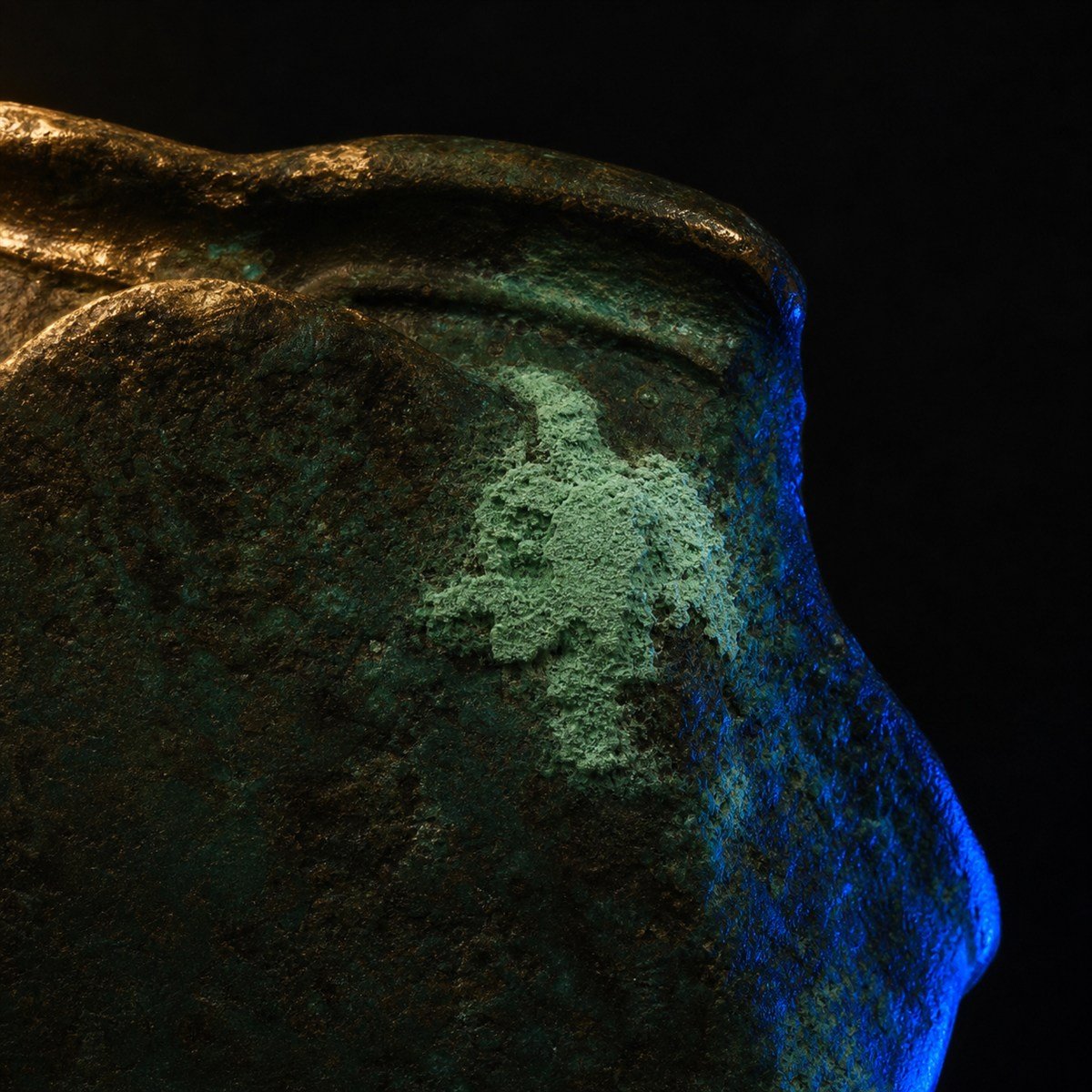
What Bronze Disease Is
Bronze disease is not a disease in the medical sense. It is the established term for active chloride corrosion in copper alloys. The cause is chloride contamination accumulated in the metal during centuries of burial in soil or exposure to seawater.
Chemically, copper chlorides react with moisture in the air and form new corrosion products, allowing the cycle to continue. The object effectively consumes itself from within.
How to Distinguish It from Patina
Original patina is hard, coherent and closely attached to the metal. Its colour can range from dark brown to green depending on alloy composition and storage conditions.
Bronze disease is loose, powdery and easily shed. It often appears as clearly defined pale-green spots or ‘blooming’ areas. If touched, powder may remain on the finger.
Why Waiting Is Dangerous
A common misconception is: ‘The object survived two thousand years; another year will not matter.’ It can matter. While buried, chlorides may have been isolated from atmospheric moisture. Once excavated and exposed to room air at 40–60% relative humidity, active corrosion may begin or accelerate.
At the first signs of active corrosion, prompt consultation with a conservator is recommended. The earlier the intervention, the less work may be required and the less original material may be lost.
Why Green Colour Alone Proves Nothing
Owners usually notice colour first, while a specialist evaluates surface behaviour. A stable green patina may be dense, hard and historically significant. An active area is usually loose, lighter than its surroundings and may reappear after gently removing already detached particles. Decisions therefore should not be based on colour alone or on a highly saturated photograph.
Colour is influenced by alloy composition, soil, humidity, contamination, old protective coatings and lighting. Even a camera's white balance can turn a calm grey-green area into an alarmingly bright one. A preliminary assessment should include an overall view, a macro photograph in diffuse light and a repeat image after several weeks. Comparison over time often reveals more than a dramatic photograph.
What Happens Inside the Corrosion Layer
Archaeological bronze rarely consists of a clean metallic core covered by one uniform shell. Between the remaining metal and the surface may lie oxides, carbonates, chloride compounds, soil particles and voids. Some layers preserve the shape of metal that has already been lost and contain evidence about manufacture. Mechanically cleaning everything to a bright surface can destroy not only patina but part of the archaeological evidence.
Chlorides are especially dangerous where they remain close to surviving metal. In the presence of moisture and oxygen, the reaction can sustain itself cyclically. A visible spot may be only the point where the process reaches the surface; the zone at risk can be much larger. The task is therefore not cosmetic removal of green powder but assessment of the depth, activity and accessibility of the corrosion focus.
A Home Observation Test That Does Not Harm the Object
Safe observation does not require scraping, acids or pressure. Place the object in a stable position, photograph the suspicious area with a scale and record the date. Keep lighting and viewpoint consistent for the comparison image. If new powder appears, the spot grows or fresh particles collect beneath the object, stop unnecessary movement and seek professional assessment.
Do not seal a damp object in an improvised plastic bag, dry it with a hair dryer or place it next to a heater. Sudden environmental changes and local heating can create new stresses. Before consultation, mechanical support, a clean inert surface and stable conditions are more important than trying to complete a chemical treatment yourself.
Diagnosis: Which Questions Actually Matter
Inspection begins by mapping the surface: where fresh corrosion products occur and whether they are associated with cracks, old seams, soldered areas or contact with another material. Edge strength, wall thickness and the role of corrosion layers in maintaining form are then assessed. The same green spot on a massive fitting and on a mineralized vessel wall requires a different strategy.
Instrumental examination is useful when it answers a specific question. Radiography can reveal internal structure and hidden joins; compositional analysis can help distinguish materials but does not by itself establish stability. Results are interpreted together with visual observation and storage history. Testing does not replace professional judgment and is not a decorative certificate.
Why Treatment Cannot Be Promised in One Day
Activity is assessed not only during treatment but afterwards. A surface may look calm immediately after local intervention, while residual chlorides may reveal themselves later when humidity changes. A monitoring period shows whether the area has stabilized and whether new points appear. Timing is determined by the condition of the object, not by the desire to produce a dramatic ‘after’ image by a fixed date.
A process that is rushed creates pressure to hide the problem under retouching or coating. Appearance improves, but the cause remains and later diagnosis becomes harder. In commercial preparation this is particularly risky: short-term presentability becomes a risk for the owner, buyer and dealer's reputation. Stabilization, observation and visual integration should be treated as separate stages.
Humidity: A Guideline, Not a Universal Switch
The Canadian Conservation Institute recommends low relative humidity for actively corroding metal objects and notes the particular vulnerability of archaeological copper alloys containing salts. But a number on a sensor cannot be read without context. Instrument accuracy, fluctuations, temperature, display-case volume, desiccant condition and materials inside the enclosure all matter.
Low humidity slows the reaction, but it does not turn an unstable object into a treated one. Desiccants require monitoring and regeneration, while sealed cases require their gaskets to be checked. Wood, some paints, adhesives and packing materials can release volatile compounds. A sound storage system combines environmental control, inert support, cleanliness and regular observation.
How to Store the Object Before It Reaches a Specialist
Position the object so weak edges do not carry weight. For a helmet this may mean a support following safe areas of the bowl; for a vessel, a supporting base that avoids lifting by the handles; for a blade, a long support without point loads. Detached parts should not be glued or forced back into place, but stored nearby in individually labelled compartments.
Transport packing should be designed after photographs have been assessed. Insurance cannot compensate for the loss of original surface, so mobile elements, safe load directions and the method of removing the object from the box are determined first. Transfer through agreed partners in Brussels or London is discussed in advance; the object should not be sent without a confirmed route and instructions.
What Should Be Included in the Agreed Scope
A professional proposal separates necessary work from optional work. Necessary measures may include safe support, local stabilization of active areas and monitoring. Optional work may include restoring the legibility of form, integrating fills or preparing the object for display. The client should understand what change each cost pays for and the consequence of declining each stage.
After inspection, the boundaries of the task may change, but never automatically. A newly discovered defect is documented, its significance explained and work continues only after agreement. The final record lists observed initial condition and completed interventions without making grand claims about authenticity or guaranteed market value.
Bronze Disease and Auction Preparation
For the market, controlled risk matters more than the illusion of a perfect surface. Fresh powder, shedding and uncertain old restoration raise questions when a lot is reviewed. A calm documented surface, clear description of treatment and handling recommendations help auction specialists assess condition, but do not guarantee acceptance or a sales result.
Trying to hide an active area with colour works against the owner. Under macro photography and close examination, texture mismatch becomes visible and confidence in the rest of the surface falls. Pre-sale work should reduce risk and restore legibility, not create a false impression of complete preservation.
Common Mistakes Made by Owners
The first mistake is to treat every green area as dangerous and begin aggressive cleaning. The second is to mistake a loose active focus for noble patina and wait. The third is to rely only on room humidity while ignoring the display case and packing. The fourth is to carry the object by projecting elements. The fifth is to ask for the problem to be ‘covered with colour’ before stabilization is complete.
All these mistakes have one thing in common: the decision comes before diagnosis. The correct sequence is the reverse — document, compare, assess structure and environment, agree the intervention limit, perform what is necessary and observe. This sequence preserves more original material.
When to Seek Urgent Advice
Do not postpone consultation if pale-green powder reappears, the area grows, fresh particles collect beneath the object, a crack opens or an old seam changes position. Leave the object undisturbed, photograph the changes and describe storage conditions. Do not test strength by pressing.
Even if the surface appears stable, consultation is useful before transport, sale or a change of display case. Preventive action is usually cheaper than correcting damage. The minimum cost of work starts at €300 because even a local task requires intake, inspection, preparation of a safe work area, material selection, photographic documentation and a final record.
Conclusion: Treat the Process, Not the Colour
Bronze disease is a convenient name, but it covers objects with different histories, structures and degrees of mineralization. There is no universal operation. A good solution preserves significant layers, reduces corrosion activity, avoids unnecessary stress and includes subsequent monitoring.
You can begin with overall photographs, the interior and suspicious areas. A preliminary response will help determine urgency and the safest next step. Final scope and cost are confirmed after physical inspection of the object.
Practical Situations: How Risk Appears
These situations illustrate decision-making logic. They are not a remote diagnosis and do not replace physical inspection of the specific object.
1. A Corinthian Helmet with One Bright Spot
Observation.On a dense dark-green surface, pale powder appears near an old crack while the overall appearance remains convincing.
Professional decision.A localized symptom does not prove that the affected area is small: its link to a crack may indicate an internal salt zone. The form and observed activity are documented first, then access to the focus is selected without wholesale cleaning of the bowl.
What matters to the owner.Do not brush away the powder for a photograph; take a macro image with scale and check whether fresh shedding reappears.
2. A Chalcidian Helmet on an Old Mannequin
Observation.The object appears stable in the display case, but the lower edge rests on a rigid structure and new particles are visible nearby.
Professional decision.Chemical and mechanical risks are considered together: pressure from the support may open a mineralized edge. The project includes temporary support, corrosion assessment and a new mount that carries weight through safe zones.
What matters to the owner.Do not lift the helmet by its edges or replace the mannequin yourself before the support method has been agreed.
3. A Thin-Walled Vessel after a Move
Observation.Before transport the surface appeared calm; after unpacking, green particles appeared on the bottom.
Professional decision.This may be fresh corrosion, shedding of an old layer or mechanical damage caused by vibration. Packing, contact zones and pre-transport photographs are compared; the decision is made after separating chemical activity from physical shedding.
What matters to the owner.Keep the packing and particles separately, do not wipe the base and describe how the object was positioned during transport.
4. A Sword with a Focus near the Hilt
Observation.Powder is concentrated near a junction of dissimilar materials and old adhesive.
Professional decision.Local moisture, contamination and material contact can sustain the process even when the rest of the surface is stable. The junction boundary, internal reinforcement and possibility of local access are assessed; cosmetic retouching is postponed until control has been established.
What matters to the owner.Do not test the hilt by twisting it and do not apply oil: it will alter the surface and complicate diagnosis.
5. Marine Bronze after Long Dry Storage
Observation.The object remained in a dry environment for years and showed activity after the container was opened in a more humid room.
Professional decision.Low humidity may have suppressed the reaction without removing chlorides; the new environment changed the equilibrium. Conditions are stabilized, changes documented and the need for active treatment versus managed dry storage is assessed.
What matters to the owner.Provide the history of discovery and storage; it is more important than assuming that years of calm mean permanent treatment.
6. Green Deposits inside a Wooden Display Case
Observation.New areas appear mainly on the side facing the display-case wall, while the room sensor shows normal readings.
Professional decision.Display-case materials and the local microclimate may differ from room air; volatile compounds and dust can increase risk. The internal environment, materials and ventilation are checked before deciding whether to move the object into an inert system.
What matters to the owner.Do not mask odours with fragrances or polish the surface; document where the areas occur relative to the display case.
7. Powder beneath a Protective Coating
Observation.The outer layer is glossy and appears intact, but pale islands and local lifting appear beneath it.
Professional decision.A coating can conceal activity and hinder the release of reaction products; adding another layer may worsen the problem. A test area is opened only after compatibility and risk to the historical surface have been assessed.
What matters to the owner.Do not puncture or dissolve the coating with household products; provide information about when the previous treatment was carried out.
8. An Old Restoration Coloured Green
Observation.Bright areas follow seam lines but do not shed or change.
Professional decision.The colour may belong to later retouching rather than active corrosion; a visual diagnosis without checking could lead to unnecessary removal. The fill material, coating and original surface are distinguished first, then the need for correction is decided.
What matters to the owner.Photograph the area in frontal and side light; do not draw conclusions from the green colour alone.
9. New Spots after Treatment
Observation.Several months later, fresh powder appears beside the former area.
Professional decision.Recurrence requires reassessment of the depth of the focus, the environment and the completeness of monitoring, not concealment. Dates, humidity and the map of affected areas are compared, after which the strategy and monitoring period are adjusted.
What matters to the owner.Inform the specialist immediately and include comparison photographs; do not interpret recurrence as proof that the object is hopeless.
10. Fragments Stored in One Bag
Observation.Several bronze fragments touch and rub against one another, while a mixture of dust and green particles is visible at the bottom of the bag.
Professional decision.The source cannot be identified, and contact causes mechanical damage and transfers contamination. The fragments are separated into labelled compartments made of suitable materials and an individual condition map is prepared for each.
What matters to the owner.Do not shake the bag or try to assemble the form; photograph the arrangement before moving anything.
11. An Object beside a Window
Observation.The surface changes seasonally, especially after cold nights and sunny days.
Professional decision.Temperature swings affect relative humidity and may cause local condensation. Move the object to a more stable area, monitor conditions and only then assess whether treatment is required.
What matters to the owner.Record readings at different times of day; a single sensor reading does not describe the environmental pattern.
12. A Helmet Being Prepared for an Urgent Sale
Observation.An active area is discovered shortly before the catalogue deadline and the owner asks for it to be covered with colour.
Professional decision.Short-term concealment creates risk for the object and for confidence in the condition description. Stabilization and an honest decision about timing take priority; if there is not enough time, postponing submission is the more responsible option.
What matters to the owner.Do not place the auction calendar above preservation; ask the venue for a new realistic deadline.
13. Green Surface on Gilded Bronze
Observation.The suspicious area lies next to surviving decorative coating.
Professional decision.Routine cleaning may remove a thin historical layer, so access and method require particular caution. The coating is documented first and the research question defined, then a local minimum intervention is selected.
What matters to the owner.Do not rub the area to test for shine and make sure to report the suspected gilding.
14. A Stable Object That Is Frequently Handled
Observation.No active foci are visible, but the surface becomes contaminated and projecting parts are used as handles.
Professional decision.Skin salts, dust and repeated loading create future risk that may not be immediately visible. The solution may be limited to handling instructions, gloves, a tray and proper support.
What matters to the owner.Change the handling habit before a problem appears; prevention preserves more original material.
15. An Unidentified Green Find with No History
Observation.There is no information about soil, previous treatment or length of storage; the colour is uneven.
Professional decision.Uncertainty increases the importance of documentation and observation, but it is not a reason for aggressive cleaning. An initial map is created, the structure clarified and only actions justified by observed risk are selected.
What matters to the owner.Provide any old photographs, invoices or messages from the previous owner — they may help reconstruct part of the object's history.
Owner’s working roadmap: from the first question to the final result
1. Record the baseline condition
When dealing with active corrosion, the first document is not a formal certificate but a clear initial record. Photograph the overall view, interior, base and problem areas with a scale. It is especially important to record fresh pale-green powder, recurrence of spots and particles collecting beneath the object. A date and consistent viewpoint allow real change to be distinguished from impressions created by light or memory.
Add dimensions, weight, known storage history and previous interventions. Do not improve the surface before photography: powder, dust, fragment position and traces of old adhesive may be diagnostically important. A good enquiry does not need to look attractive; it needs to help identify risk.
2. Define the objective
Describe what the object is being prepared for: storage, display, research, transfer to a new owner or sale. The same problem may have different acceptable solutions. For active corrosion, the common objective is to reduce activity, preserve significant layers and establish a realistic monitoring regime. That is more precise than asking for the object to be ‘fully restored’.
The objective defines the treatment limit but does not override safety. If the desired appearance threatens original material, the conservator should propose a more restrained route. It is useful to separate essential actions from desired presentation in advance.
3. Do not create a new risk
Before consultation, avoid scraping, acids, polishing and sealing an active focus under lacquer. Do not test strength by pressing, do not force a detached element back into place and do not carry the object by projecting parts. Even a small action can alter a crack boundary and remove valuable evidence for the specialist.
If the situation appears urgent, the safest first step is stable positioning, minimal handling and photographs. Urgency means obtaining advice quickly, not applying an improvised treatment quickly.
4. Understand the limits of photographs
Images help establish the direction of discussion, but physical inspection reveals weight, stiffness, sound, mobility and internal materials. With active corrosion it is especially important to assess the activity map, interior, links between foci and cracks, and humidity history. Without these data, an exact price and guaranteed result would be speculation.
A preliminary range is still useful because it helps determine whether transfer of the object is justified. After examination, however, the plan is confirmed or adjusted. This sequence is professional caution, not an attempt to change the agreement.
5. Separate observation from interpretation
‘A pale loose area is visible on the surface’ is an observation. ‘This is an active process of a particular type’ is an interpretation that requires context. With active corrosion, keeping these statements separate protects against confident claims based on one sign and explains why additional data are sometimes needed.
The record should distinguish what is known, what is suspected and what action is proposed to test the assumption. The client can then see the logic of the decision and understand where uncertainty remains.
6. Choose the minimum sufficient action
Minimal intervention does not mean low quality. It means every action addresses a named problem and does not extend into safe areas. The priority is to preserve dense historical patina, weak edges and the associated corrosion structure. If the result can be achieved with support, local stabilization or observation, extensive intervention does not become mandatory.
After each significant stage, the condition is reassessed. The ability to stop is more valuable than a promise of maximum transformation made in advance. This is how the risk of irreversible error is controlled.
7. Agree on alternatives
A good proposal contains several levels: the essential minimum, possible restoration of readability and optional visual integration. The benefit, limitations and consequences of declining each level are explained. The owner makes an informed choice rather than receiving a single all-or-nothing package.
If a hidden defect changes the task, work stops at a safe stage. The revised option, schedule and cost are agreed in writing. The presence of the object in the studio is not permission for unlimited additional work.
8. Calculate time and cost
The minimum treatment cost starts at €300 because even a local task includes intake, examination, preparation of a safe work area, materials, photographic documentation and a final record. A more complex project also accounts for the number of fragments, access, weak edges, temporary fixation, monitoring and packing.
Time depends on condition, not only on the number of operations. Monitoring and correct sequencing cannot simply be removed to meet a deadline. If a sale timetable conflicts with safety, the timetable should be reconsidered.
9. Prepare for storage
The result is preserved by its environment. Active corrosion requires a dry, stable environment, inert support, a functioning sensor and regular observation. Average readings are not enough: fluctuations, contact materials, dust, sunlight, heating and the way the object is removed from a display case also matter.
Recommendations must be realistic for the owner. A complex system that is not maintained is worse than a simple, understandable support and regular checks. Changes should be documented photographically rather than judged only from memory.
10. Plan the transfer
Packing begins with the load path: which areas can carry weight, what must not touch the container walls and how the object will be removed. Insurance can compensate financial loss, but it cannot restore original surface. Custom mechanical support therefore matters more than the impressive appearance of the box.
Transfer through partners in Brussels or London is possible by prior arrangement. The intake point, route, accompanying documents and unpacking procedure are defined for each project. Do not send an object without confirmation.
11. Prepare the object for the market without promises
In a commercial context, active corrosion requires stability and a transparent description of active and treated areas. The studio is responsible for the agreed condition, but it does not issue attribution, insurance valuation or guarantees of acceptance or price. Those decisions are made by the relevant experts, dealers and auction houses.
Published results from previous projects demonstrate experience but do not predict the outcome of a new lot. Honest information and a stable object create more trust than dramatic concealment.
12. Review the outcome
Before handover, compare the original task with the result: has the stated risk been addressed, was the agreed treatment limit respected, and are the intervention areas and recommendations clear? The final record should be concise but sufficient for a future owner or conservator.
A high-quality result with active corrosion is not the maximum amount of work. It is reducing activity, preserving significant layers and establishing a realistic monitoring regime. If the object requires continued observation, that is stated as part of the solution rather than hidden behind the word ‘ready’.