 Explore the Method
Preliminary AssessmentPractical Value
What matters to a private owner and an antiquities dealer
A historic object must be not only stable, but also visually convincing. Buyers judge its form, the legibility of details, the integrity of the surface, the quality of the patina and the overall impression. Restoration within MARCHENKO METHOD™ therefore solves two tasks at once: it reduces the risk of further deterioration and makes the object presentable without turning it into a modern copy.Presentable Form
Restoration of geometry and visual integrity.
Preparation for SaleThe object becomes easier to photograph, describe and present to a buyer.
Protection of the ResultRecommendations and individual storage systems.
Good restoration makes an object convincing. Excellent restoration makes the restorer’s work itself disappear from view.From Diagnosis to Long-Term Storage
Protection of the ResultDiagnosis
Discreet Interventions
Joints and additions do not draw attention to themselves.
Good restoration makes an object convincing. Excellent restoration makes the restorer’s work itself disappear from view.
From diagnosis to long-term storage




Photography, captions and object history.
Contents
About the Author
There is only the right decision for a specific object.
This is the principle on which MARCHENKO METHOD™ is based.
During that time, more than a thousand objects of varying complexity have passed through my hands: helmets, swords, knives, vessels, jewellery, elements of armour and tableware. Years of practice led me to a simple conclusion:
Purpose of the Method
My task has never been to make an object look new.
I do not try to hide its age.
Purpose of the Method
Every decision must meet three requirements:
preserve historical authenticity;
provide mechanical strength;
ensure long-term stability of the object;
make the object attractive for sale.
- If several solutions are possible, the one that causes the least harm to the original material is always preferred.
- 💭 Working Philosophy
- 🏛️ Restoration is not an attempt to defeat time. It is an attempt to reach an agreement with it. A good restorer does not erase the age of an object; he helps it live another life.
- make the object attractive for sale.
Core Principles of MARCHENKO METHOD™
1. History matters more than appearance
Original metal cannot be replaced.
Core Principles of MARCHENKO METHOD™
2. Every object is unique
There are no identical objects in archaeological restoration.
Even two bronze helmets from the same period may require completely different restoration methods.
There are therefore no universal solutions.
3. Diagnosis matters more than the tool
Most mistakes are made before restoration even begins.
An incorrect assessment of the metal can lead to irreversible losses.
This is why diagnosis occupies a central place in my work.
4. Modern technology should support experience, not replace it
Microscopes.
Plasma cleaning.
Electrochemical activation.
Modern protective coatings.
Controlled-atmosphere storage.
All of these are tools.
But the decision is always made by the restorer.
5. The work does not end after restoration
Even a perfectly restored object can begin to deteriorate again if it is stored incorrectly.
MARCHENKO METHOD™ therefore treats restoration, conservation and storage as one continuous process.
But the decision is always made by the restorer.
Who the Method Is For
MARCHENKO METHOD™ is intended for work with:
🏛 museums;
Who the Method Is For
📦 antiquities dealers;
🔨 restoration studios;
🎓 archaeologists;
👑 owners of family heirlooms.
📦 antiquities dealers;
What the Client Receives
Every project is approached individually.
Depending on the condition of the object, the work may include:
What the Client Receives
development of a restoration strategy;
stabilisation of corrosion processes;
restoration of form;
low-temperature soldering or internal reinforcement;
local reconstruction of patina;
protective conservation;
recommendations for further storage;
development of an individual sealed container for long-term storage and display of the object.
💭 Philosophy of MARCHENKO METHOD™
🏺 History cannot be restored. It can only be preserved.
Every object passes through my hands only once. That is why every decision must be considered, understandable and justified.
I do not work from templates.
I study the object.
I understand its condition.
I choose the safest route.
Only then do I begin the restoration.
I study the object.
Diagnosis
🔍 The foundation of correct restoration
No restoration should begin with cleaning, soldering or consolidation. The first stage is understanding what is in front of you.
Diagnosis
During diagnosis, I evaluate:
condition of the metallic core;
depth of mineralisation;
activity of bronze disease;
presence of previous restorations;
- internal stresses and cracks;
- mechanical strength of the structure;
- whether soldering is possible or another joining method is required.
- Methods used
- visual examination;
- microscopic examination;
- macro photography;
local mechanical probing;
analysis of previous restoration interventions.
Diagnosis continues throughout the entire treatment. After every stage, the condition of the object is reassessed because the original plan may need to be adjusted.
💭 Working Philosophy
🔍 A good craftsman looks for answers first and only then reaches for a tool. A wrong diagnosis can destroy more than a thousand years of corrosion.
analysis of previous restoration interventions.
Cleaning
🛡️ Preserve more than you remove
The purpose of cleaning is not to make the object shine.
Cleaning
During cleaning, the following may be removed:
active corrosion products;
loose oxides;
contamination;
soil residues;
unstable salts.
Methods used
mechanical cleaning under a microscope;
fibreglass brushes;
micro-scalpels;
local ultrasonic cleaning;
- chemical cleaning only when indicated.
- Every intervention should be as reversible as reasonably possible.
- 💭 Working Philosophy
- 🛡️ Every millimetre of original metal is more valuable than a perfectly polished surface. Lost history cannot be recreated by any chemistry.
- chemical cleaning only when indicated.
Preparation for Joining
⚙️ The foundation of a strong joint
Practice shows that most failed joints originate not during soldering but much earlier, at the stage of surface preparation.
Preparation for Joining
oxides;
grease;
salts;
residues of old adhesives;
products of previous restorations.
Main preparation methods
micro-abrasion;
fibreglass brush;
local ultrasonic cleaning;
plasma surface activation;
- electrochemical activation immediately before joining.
- Particular attention is given to electrochemical activation, which has proved highly effective when working with thin archaeological bronze. The method prepares the surface for joining with minimal mechanical impact.
- 💭 Working Philosophy
- ⚙️ Most failed joints are born before the joining process begins. Surface preparation matters more than the joining operation itself.
- electrochemical activation immediately before joining.
Joining and Form Reconstruction
🧩 Two routes. One goal.
The purpose of joining is not merely to fasten fragments together, but to restore the structural integrity of the object while preserving as much original material as possible.
Joining and Form Reconstruction
Used only when the object retains sufficient mechanical strength and is capable of forming a reliable metallic joint.
Materials may include:
low-temperature silver solders;
specialist conservation solders;
experimental copper-based compositions with reduced melting temperatures.
The key principle is minimum heat with maximum reliable strength.
Method 2. Joining and restoring form without soldering
If the bronze is fully mineralised, friable or saturated with oxides, soldering may simply be impossible and can even destroy the object.
In such cases, internal reinforcement is used.
All reinforcing elements are placed only on the inside so that the external appearance remains as authentic as possible.
Reinforcement materials include
fibreglass fabric substrates (primary material);
fibreglass mesh;
bronze mesh;
copper mesh;
- thin metal substrates;
- reinforcing micro-plates.
- The aim is not to replace the original metal with a new structure, but to create internal support that allows the historic form to be preserved. Reinforcement is placed on the inside or on a side that does not draw the eye and does not disturb perception of the original surface.
- This method is particularly effective for heavily mineralised archaeological helmets, vessels and other thin-walled objects.
- 💭 Working Philosophy
- 🧩 If an object cannot be soldered safely, it should not be forced to accept solder. My task is not to defeat the metal, but to preserve it. Sometimes internal reinforcement is the only way to return the form without taking away its history.
The aim is not to replace the original metal with a new structure, but to create internal support that allows the historic form to be preserved. Reinforcement is placed on the inside or on a side that does not draw the eye and does not disturb perception of the original surface.
Post-Joining Control
🔬 Verification of the result
The work does not end when the fragments have been joined.
Post-Joining Control
removal of flux residues (when soldering is used);
microscopic inspection of the joint;
checking for new cracks;
assessment of mechanical strength;
- analysis of possible internal stresses;
- preparation of the surface for subsequent restoration stages.
- Only after successful control can work proceed to colour integration, patination and protective conservation.
- 💭 Working Philosophy
- 🔬 Restoration ends not when the object looks beautiful, but when I am confident that it will continue to survive.
- preparation of the surface for subsequent restoration stages.
Artificial Patina
🎨 A finishing stage that should not call attention to itself
Patination is one of the most responsible stages of restoration.
Artificial Patina
It should be perceived as a natural continuation of the object’s history.
During the work, I take into account:
colour of the original surface;
structure of the ancient patina;
degree of wear;
future storage conditions;
compatibility of materials.
Where necessary, local patina is created exclusively on areas of restoration intervention.
The main objective is to preserve the visual integrity of the object without turning it into a modern copy.
💭 Working Philosophy
🎨 The art of restoration is to ensure that the viewer sees the ancient object, not the restorer’s work. The best compliment is when the intervention cannot be found.
Where necessary, local patina is created exclusively on areas of restoration intervention.
Protective Coating
🛡️ Protection, not disguise
After restoration, the surface requires protection from moisture, oxygen and contamination.
Protective Coating
- chemically stable;
- do not alter the appearance of the metal;
- do not create an obvious gloss;
- can be removed without damaging the original surface;
- have a long service life.
Any coating must remain an auxiliary protective element rather than becoming part of the visible character of the object.
💭 Working Philosophy
🛡️ A protective coating should work silently. It must protect the metal, not draw attention to itself.
Long-Term Storage
📦 Restoration continues beyond the workshop
Even an impeccably executed restoration cannot ensure long-term preservation if the storage conditions are wrong.
The main risk factors remain:
elevated humidity;
rapid temperature fluctuations;
oxygen;
active salts;
polluted air;
inappropriate packaging.
For most archaeological objects, a stable microclimate without abrupt environmental changes is recommended.
Each object should be stored in a way that avoids mechanical stress and continuous exposure to humid air.
💭 Working Philosophy
📦 Even the finest restoration is useless if the object is stored incorrectly. Preservation begins not in the workshop, but in the place of storage.
Sealed Display and Storage Cases
🌡️ The next stage of preservation
One direction in the development of MARCHENKO METHOD™ is the creation of purpose-designed transparent sealed cases for storing and displaying archaeological objects.
Their purpose is to provide the object with a stable, controlled environment while preserving the possibility of full display.
Each case is designed individually, taking into account:
the dimensions of the object;
its weight;
its structural characteristics;
its state of preservation;
transport requirements;
storage conditions.
Where required, the case can be equipped with:
- a humidity indicator;
- silica gel;
- an oxygen absorber;
- museum-grade inert materials;
- a concealed support system for the object.
Such cases are intended for:
🛡️ archaeological helmets;
⚔️ swords;
🗡️ knives and daggers;
🏺 bronze vessels;
archaeological artefacts of any complexity.
Advance Booking
Because every case is made for a specific object, mass production is not planned.
Museums, collectors and dealers can already reserve a place for the development of an individual case.
This makes it possible to agree the design and storage requirements in advance and reserve a place in the production schedule.
💭 Working Philosophy
🌡️ The best preservative is not a new chemical formulation. It is a stable environment in which corrosion has nothing to feed on.
Controlled Atmosphere and Vacuum
⚖️ When air becomes part of conservation
Not every object requires a vacuum.
Not every object requires complete removal of oxygen.
The decision is therefore always made individually.
Depending on the condition of the metal, the following may be used:
sealed storage;
partial reduction of oxygen content;
oxygen absorbers;
controlled humidity;
a combination of several methods.
The main objective is to create the most stable possible environment suited to the specific object.
Sometimes a change in storage conditions alone can halt corrosion without further intervention.
💭 Working Philosophy
⚖️ There are no universal solutions in conservation. What helps one object may destroy another. Every decision therefore has to be justified.
Start of form
Oxygen Control
🌬️ When less means better
Oxygen is one of the main factors that sustains corrosion processes. However, complete oxygen removal is not always the correct solution. For each object, the condition of the metal, the presence of active bronze disease and the intended storage conditions are assessed individually.
Oxygen control is treated as one tool of long-term preservation, not as a universal solution to every problem.
Depending on the objective, the following may be used:
sealed cases;
oxygen absorbers;
an inert atmosphere;
combined microclimate-control systems.
The main aim is to slow deterioration and provide the most stable possible storage conditions without additional intervention on the object itself.
💭 Working Philosophy
🌬️ Sometimes the best way to preserve metal is not to add new substances, but to remove what is slowly destroying it.
Humidity Control
💧 Water is corrosion’s principal ally
Most deterioration processes affecting archaeological bronze cannot proceed without moisture.
Even a small increase in relative humidity can reactivate bronze disease years after treatment.
For this reason, humidity control is an essential part of long-term storage.
The following may be used:
- indicating silica gel;
- electronic humidity sensors;
- sealed cases;
- periodic monitoring of the microclimate.
Silica gel should not simply remain inside the case; it must be checked regularly and regenerated or replaced when required.
Humidity control is a continuous process, not a one-off measure.
💭 Working Philosophy
💧 Moisture is the most patient enemy of archaeological bronze. It can wait for years before beginning to destroy the object again.
Condition Monitoring
📅 Restoration does not end when the object is returned to its owner
Even after successful restoration, the object continues to change over time.
Storage conditions change.
Ambient humidity changes.
The object is transported.
It may pass into another collection.
It may be displayed at exhibitions.
For this reason, periodic condition monitoring is as important a part of the method as cleaning or structural reinforcement.
It is advisable to check regularly:
surface condition;
the appearance of new corrosion sites;
patina colour;
humidity level inside the case;
condition of the silica gel;
effectiveness of oxygen absorbers;
mechanical stability of joints.
Early detection may allow a problem to be corrected in minutes, whereas late discovery can result in another complex restoration.
💭 Working Philosophy
📅 Proper conservation continues after the object has been returned to its owner. Condition checks are as much a part of the work as cleaning or reinforcement.
Research and Development of the Method
🚀 A method that continues to evolve
Restoration practice is constantly evolving.
New materials appear.
Analytical methods improve.
New protective coatings are developed.
Technologies are being developed that only a few years ago seemed impossible.
MARCHENKO METHOD™ should not be regarded as a finished project.
Every successfully restored object becomes part of the accumulated experience and helps refine the methodology.
Current areas of development include:
new approaches to stabilising archaeological bronze;
improved internal reinforcement without soldering;
development of electrochemical surface-preparation methods;
development of new low-temperature joining materials;
development of transparent, sealed museum-grade cases;
improvement of long-term controlled-environment storage systems.
My aim is not simply to use modern technology, but to develop solutions that genuinely help preserve historical objects for future generations.
💭 Working Philosophy
🚀 The method can never be considered final. Every new technology, successful experiment and saved object makes it better.
Catalogue of MARCHENKO METHOD™ Solutions
Beyond Restoration
Within MARCHENKO METHOD™, bespoke solutions are developed for collectors, museums and antiquities dealers.
🛡️ Sealed Display and Storage Cases for archaeological helmets
Custom transparent cases with a controlled internal environment for the storage and display of bronze and iron helmets.
⚔️ Cases for swords
Special sealed storage systems for long-bladed weapons with individually designed supports.
🗡️ Cases for knives and daggers
Compact storage solutions for smaller archaeological objects, with protection from moisture and oxygen.
🏺 Universal cases
Custom designs for vessels, jewellery, armour elements and other archaeological finds.
📌 Advance Booking
Every case is made specifically for an individual object.
Each project is designed individually, taking into account:
dimensions;
weight;
state of preservation;
storage and display requirements.
For this reason, mass production is not planned.
Advance booking is already open for museums, collectors and dealers.
It allows you to:
- reserve a place in the production queue;
- discuss the design in advance;
- design the case before restoration is complete;
- receive a case made specifically for the object.
💭 Working Philosophy
🏛️ Restoration ends in the workshop. Preservation continues for the rest of the object’s life. That is why the case is as important a part of the method as cleaning, reinforcement or conservation.
Philosophy of MARCHENKO METHOD™
History cannot be made again.
It can only be preserved.
Every object is unique.
Every form of damage is unique.
Every decision must be made with an understanding of the material, its history and its future.
I do not try to make an object look new.
I aim to preserve its authenticity.
I do not work from templates.
I work with history.
Modern materials, scientific research and new technologies are not the goal; they are tools.
The true value of restoration is not measured by how invisible the intervention is, but by whether the object remains a living witness to its period decades later.
My motto
Respecting the past. Preserving the future.
Volodymyr Marchenko Founder of MARCHENKO METHOD™ Restoration • Conservation • Archaeological Bronze
Bespoke Storage Solutions
MARCHENKO Preservation Cases™
Transparent sealed storage and display systems designed around a specific helmet, sword, knife, vessel or other archaeological object.
For a private owner, such a system solves several problems at once: it protects the object from dust, accidental contact, humidity fluctuations and mechanical damage, while also presenting it more effectively for display, photography and presentation to a potential buyer.
- custom geometry and concealed support;
- transparent display construction;
- humidity indicator and space for silica gel;
- option to use an oxygen absorber after assessment of the object;
- inert materials at contact points;
- system documentation and maintenance recommendations.
Advance booking is open.
Each system is made for a specific object, so design begins with photographs, dimensions and an assessment of its condition.
Request a Preliminary Assessment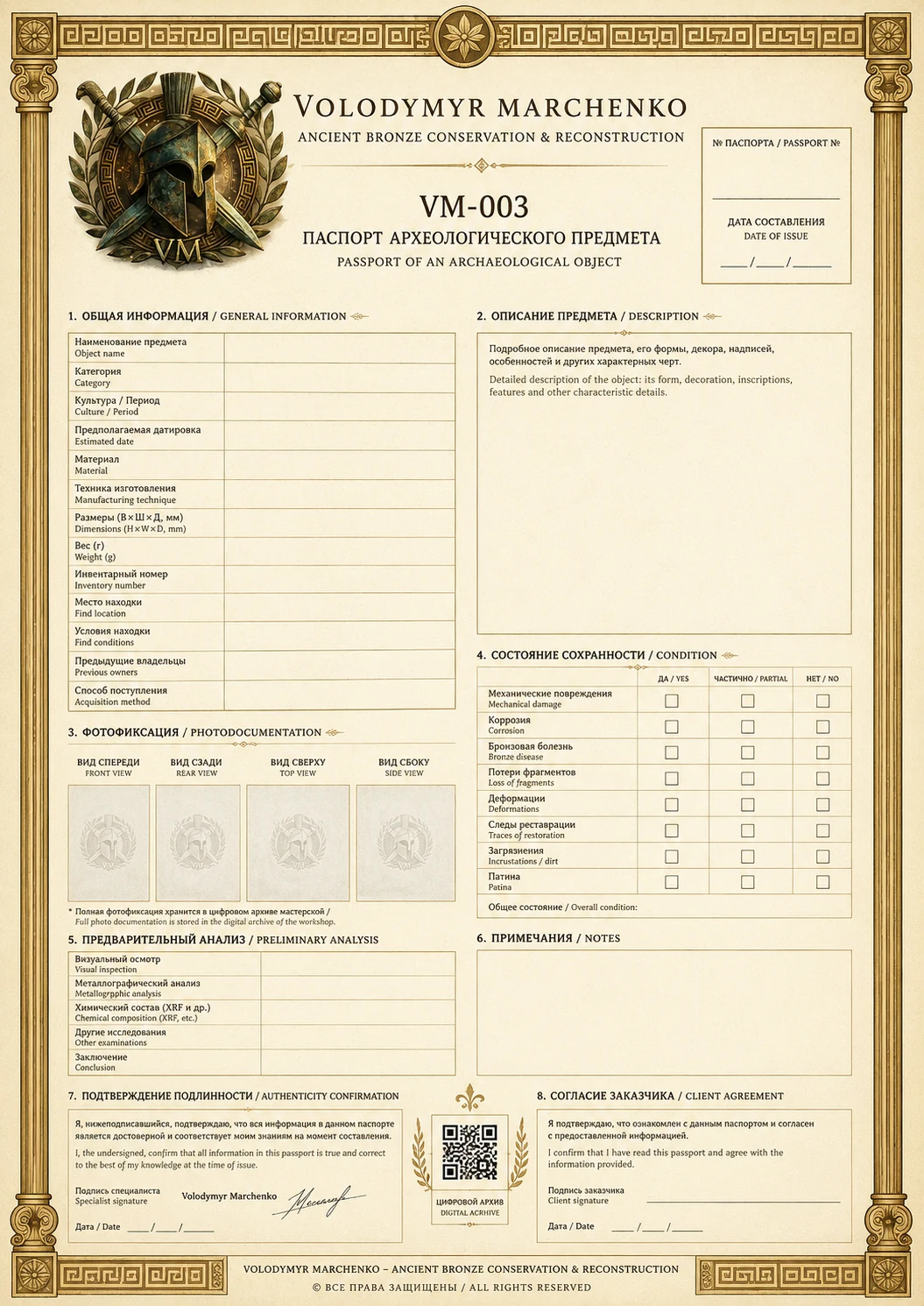
Questions from Owners and Dealers
Answers to Practical Questions
This section brings together the questions most often asked before work begins, during restoration, and when preparing an object for sale or storage.
Diagnosis and Condition
Back to categories ↑Can a severely damaged bronze object be restored?
In many cases, yes. I often take on work that others have already declined, because difficult objects force us to find new solutions and develop the method. However, the surviving original material always sets the limit. A heavily deformed object assembled from many small fragments can resemble a complex puzzle in which some pieces have been lost permanently. Missing areas then have to be reconstructed. The feasibility of restoration depends on how much of the form survives, the strength of the mineralised layer and the presence of supporting areas. If soldering is impossible, internal reinforcement may be made with fibreglass fabric, fibreglass mesh, copper mesh or bronze mesh.
What is bronze disease?
It is an active, cyclic corrosion process, often associated with chlorides and moisture. It appears as loose, pale-green corrosion spots and may continue damaging the object even after cleaning.
Can bronze disease be stopped permanently?
An absolute guarantee cannot be given for every archaeological object. Bronze disease behaves more like a chronic process: active sites can be removed or stabilised, but aggressive removal of affected areas can sometimes mean losing the object itself. My task is therefore to slow deterioration as much as possible, reduce humidity, control the environment and give the owner clear recommendations for continued monitoring.
Will the object look new?
No, not if the objective is defined correctly. The aim is to restore a readable form and good presentation while preserving age, patina and the character of the original surface. I also listen carefully to the client, because every owner has a different idea of the desired result. The important point is not to cross the line at which excessive polishing or complete removal of the patina begins to reduce the object’s credibility and market appeal.
How long does restoration take?
The time required depends on the size of the object, number of fragments, corrosion activity, previous interventions and the client’s requirements. Pre-sale preparation of a relatively stable object often takes 2–3 days. Assembly or reinforcement of large fragments takes around 4–5 days. Correcting a poor earlier restoration that requires partial or complete disassembly may take two weeks or more. Complex engineering solutions, casting of missing decorative parts and work involving partners can sometimes take several months. I try to work as efficiently as possible and do not extend the process simply to increase the cost; an agreed budget normally changes only within a tolerance discussed in advance.
Do you work only with bronze?
My main specialisation is archaeological bronze, copper, ceramics and other non-ferrous metals. Work on iron and complex composite objects is discussed separately. I do not take on a field simply for the sake of receiving an order: if another specialist has more appropriate equipment and can do the work better, I prefer to recommend that specialist.
Is the system suitable for helmets, swords and knives?
Yes. The system is designed around the form, weight and condition of the individual object. Helmets, swords, knives and daggers require different support methods and different case proportions.
Will the restored area be completely invisible?
The aim is to make the intervention visually quiet and unobtrusive. Complete invisibility depends on the condition of the original, the lighting and the acceptable extent of reconstruction. I usually achieve a very close match to the original patina, but no result can be guaranteed to be identical. As with any skilled handwork, some results are good and some are exceptional.
How do I start a project?
Send photographs, dimensions, any known history of the object and a description of the task: restoration for a collection, preparation for sale, stabilisation or a storage system. It is also useful to show an example of the result you prefer. I have a professional view of how an ancient object should look, but I do not regard it as the only possible approach. During the planning stage it is important to understand the owner’s expectations as accurately as possible. We then choose a convenient and safe way to transfer the object; for many clients, our logistics contacts in Brussels and London are suitable.
How can I tell whether bronze disease is active now?
Warning signs include fresh loose pale-green spots, powdery areas, the reappearance of green corrosion after cleaning and local flaking of the surface. A reliable assessment requires examination under magnification and evaluation of the storage conditions.
Why can bronze disease return after restoration?
The most common causes are residual chlorides, high or unstable humidity, insufficient stabilisation or unsuitable storage. Surface treatment without environmental control may therefore provide only a temporary result. Removing chlorides and soluble salts can be a lengthy and labour-intensive process, sometimes taking from one month to six months, and is often avoided because of the time and cost involved. For that reason, storage conditions should be kept as close to ideal as reasonably possible.
How can original metal be distinguished from an earlier restoration?
Visual examination, microscopy and differences in patina, structure, hardness and joining traces are used. In some cases, old inserts become recognisable only after local cleaning or additional analysis. Poor earlier repairs are often visible to the naked eye because of rough joint finishing or the use of unsuitable materials such as automotive filler, metal-filled repair compounds, cyanoacrylate adhesive or other improvised materials.
Can a poor previous restoration be corrected?
In many cases, yes, but first I assess how deeply earlier materials have penetrated the surface and whether they can be removed without loss of original material. This is discussed with the client because it is additional work and may involve unpleasant or hazardous fumes when the composition of old repair materials is unknown. Usually only the roughest or least reliable areas are dismantled. Complete disassembly can add roughly 30–50% to the cost of the work, so it is not always economical for the client.
Can an attractive restoration conceal a forgery?
Restoration does not establish authenticity and should not replace provenance or attribution expertise. I can give a practical opinion about materials, construction and traces of intervention, but I do not present it as an official attribution. If authenticity is critical, a specialist in the relevant field and, where appropriate, laboratory analysis are required.
Cleaning and Patina
Back to categories ↑Should all green patina be removed?
No. Stable ancient patina is part of the object and often protects the surface. Only active, loose or harmful corrosion products should be removed.
Why is artificial patina used?
It visually integrates restored areas with the original surface. Patina is applied locally and should not turn the entire object into a uniformly coloured copy. Done correctly, it makes the object more coherent and visually convincing without drawing attention to the intervention.
Should ancient bronze be coated with lacquer?
Not always. The decision depends on the condition of the surface and the storage conditions. A thick or unsuitable coating can change colour and gloss and complicate future treatment. In many cases, a 5% Paraloid B-72 coating or a microcrystalline wax treatment is sufficient.
Which is better for protection: wax or an acrylic coating?
There is no universal answer. Wax gives a softer visual effect but requires maintenance; an acrylic coating can provide a more durable barrier, but it must be compatible with the surface and the storage environment.
Can bronze be cleaned with vinegar, citric acid or household chemicals?
For archaeological objects this is risky. Household acids can remove stable patina, activate corrosion and irreversibly alter the surface. Strong acid cleaning may strip almost everything from the bronze, including the features that give the object much of its historical and market value.
Can ancient bronze be cleaned with a metal brush?
A coarse brush can remove original surface, soften details and leave scratches. Archaeological bronze is normally cleaned locally and under magnification. Tool choice depends on the hardness and character of the patina: some patinas are extremely hard, while others are so delicate that even a wooden tool or fibreglass brush can remove them.
Why should archaeological bronze not be fully polished?
Polishing destroys patina, manufacturing traces and the aged surface. An object may become shiny but lose historical credibility and part of its collector appeal. If any polishing is appropriate, it should be minimal; wax-based products can sometimes provide a very light polish and a restrained wax sheen at the same time.
Soldering and Reinforcement
Back to categories ↑Can archaeological bronze be soldered?
Only after diagnosis. If a sound metallic core survives and heating is judged safe, low-temperature soldering may be used. Fully mineralised or friable metal often requires joining without solder. In my practical experience, controlled heating in the region of 200–250°C can be tolerated by many types of patina, but this must never be assumed in advance. On objects with relatively few fragments and sound metal, soldering can sometimes achieve a strong and visually discreet result with limited intervention.
What if the solder will not take?
The cause is usually oxides, salts, residues of old adhesive or the absence of a sound metallic core. The surface may be prepared mechanically, ultrasonically or by local activation; if a metallic bond is not possible, internal reinforcement is chosen instead. I generally avoid soldering such objects, except perhaps very locally to support the form. When the surviving metal is extremely thin or deeply mineralised, soldering can do more harm than good even if the surface still appears metallic.
How is joining carried out without soldering?
A thin supporting structure is created on the inside, following the geometry of the object. It links the fragments and distributes the load while leaving the visible surface as untouched as possible.
Is fibreglass visible after restoration?
The main support is located inside the object. Local surface modelling and colour integration are carried out externally, so the reinforcement should not draw attention. Where treatment is possible, I also try to make the interior visually coherent with the condition and age of the object.
Can missing fragments be reconstructed?
Yes, when reconstruction helps recover a readable form and is not represented as original material. Everything is discussed with the client in advance. The extent of additions depends on the purpose of the object: collection, sale, display or research. Complex missing elements can also be reconstructed, including cast bronze sword or knife handles, decorative details, and missing parts of statuettes such as limbs or heads, provided the intervention is technically and ethically appropriate for the agreed objective.
Should old adhesive and earlier solder be removed?
Only if they are unstable, interfere with the new structure, damage original material or seriously impair the appearance. A stable earlier intervention can sometimes be safer to retain.
Sale and Documentation
Back to categories ↑Can an object be prepared for auction or sale?
Yes. Work may include diagnosis, restoration of form, visual integration of restored areas, local patination, photographic documentation and recommendations for safe packing. My partners can also provide a complete cycle of documentation and analytical preparation for auction when required.
Does restoration increase an object’s value?
Market value is determined by authenticity, rarity, provenance, demand, acquisition cost and the overall quality of the object. Professional restoration cannot guarantee a specific increase in price, but it can make an object more coherent, understandable and attractive to a buyer. I have seen substantial increases in value in practice, but every case is individual and I never promise a predetermined percentage.
Can an object be assessed from photographs?
Good photographs are often sufficient for a preliminary assessment and identification of potential risks. The final treatment decision is made after direct examination of the object.
What photographs are needed for an assessment?
Provide overall views from all sides, close-ups of cracks and corrosion, the interior surface, areas of previous joins, and a scale or ruler beside the object. The more information available, the more accurate the estimate of the work can be.
How should a bronze helmet be prepared for sale?
Typical preparation includes diagnosis, correction of geometry where appropriate, stabilisation of friable areas, visual integration of joins, local patination, high-quality photographic documentation and packing recommendations. The aim is to present the object as a coherent whole so that attention is directed to its strengths rather than avoidable restoration distractions.
How should an archaeological sword or knife be prepared for sale?
It is important to stabilise corrosion, reinforce fragile areas, provide safe support, show the form clearly and preserve the readability of the original surface. Correct packing and support are particularly important for long objects. Where the surviving material allows it, recovering the intended overall form and structural coherence is highly desirable.
Which defects are most likely to discourage a buyer?
Active corrosion, obvious rough seams, bright fresh solder, mismatched patina, distorted geometry, unstable fragments and a lack of clear information about previous work are all significant concerns. In some cases the original form cannot be fully recovered because of the object’s condition, but even limited stabilisation and improvement of the geometry can have a positive effect.
Should restoration be disclosed to a buyer?
A transparent description of interventions reduces the risk of disputes and increases trust. An object record, photographs and a brief report help present the condition accurately. Confidentiality is also part of my work: if an agreement prohibits disclosure of the object’s initial condition or the owner’s details, I strictly observe that condition.
Do you certify authenticity?
A restoration condition assessment is not the same as an expert opinion on provenance or authenticity. Documentation can record observable materials, construction and traces of intervention without presenting them as an attribution. I do not issue formal authenticity certificates, but at the client’s request I can help arrange an opinion from an appropriate specialist.
Does a private owner need an object record or conservation passport?
It is useful for preserving the history of the object and recording its condition, restoration work, dimensions, photographs and recommendations. When the object is sold, such documentation can make its presentation more professional. A private owner may choose not to circulate my treatment report if they do not wish to disclose the object’s initial condition; disclosure is governed by the owner’s instructions and any applicable legal requirements.
How should a bronze object be packed safely for shipment?
The object should not be able to move freely inside the package. Use inert cushioning materials, separate support for projecting parts, double packaging and insurance based on the declared value.
Can a fragile object be shipped internationally?
Yes, provided this is permitted by law and the object’s provenance is appropriately documented. Packing, insurance, customs documentation and any restrictions relating to cultural property should be checked before shipment.
Storage and Preservation Cases
Back to categories ↑What humidity is safe for archaeological bronze?
For vulnerable bronze, the aim is generally a stable, reduced relative humidity. The appropriate range depends on the condition of the object and the design of the storage system.
Is vacuum storage necessary?
Deep vacuum is rarely a universal solution because it can place stress on fragile areas. A sealed chamber with controlled humidity and, where appropriate, reduced oxygen is often preferable.
What is a Preservation Case?
It is a custom transparent storage and display system with safe support, humidity control and space for consumable conditioning materials. It is designed around the dimensions and condition of a specific object.
Can a storage system be ordered without restoration?
Yes, after an assessment of the object’s condition. It is important to confirm that the object is stable and that the chosen internal environment will not introduce additional risks.
How is a sealed storage system maintained?
The humidity indicator, silica gel, seals, supports and the object’s surface should be checked periodically. The recommended maintenance interval is specified in the system documentation.
Can an object be transported in such a system?
Suitability for transport depends on the design. A display case and a transport case have different requirements; additional restraint can be developed where necessary.
Can archaeological bronze be kept in an ordinary display case?
Yes, if the object is stable and room humidity remains predictable. However, an ordinary display case mainly protects against dust and accidental contact; it does not guarantee control of humidity or air composition.
Is silica gel needed for storing bronze?
Often yes, particularly in a sealed or partly sealed enclosure. The quantity, type and regeneration interval should suit the size of the case and the condition of the object.
How often should silica gel be replaced or regenerated?
This depends on the quality of the seal and the external humidity. Checks are made using an indicator and sensor; in a stable system servicing may be required only every few months, while in a poorly sealed system it may be needed much more often.
Can an oxygen absorber be used together with silica gel?
Yes, but only after assessing the condition of the object and the risk of condensation. Reducing oxygen does not replace humidity control and should not be applied automatically.
Why can deep vacuum be dangerous for an ancient object?
It creates a pressure differential that may affect fragile cavities, loose corrosion products and older repair materials. For most private collections, a controlled sealed environment without deep vacuum is safer.
The object should look convincing — and remain stable after the sale.
Individual commissions are accepted from private collectors, antiquities dealers, owners of historical objects and family collections. For a preliminary assessment, photographs, dimensions and a brief description of the task are sufficient.
Submit an Object for AssessmentPreserve Authenticity. Reveal Value.Preserve authenticity. Reveal value.