
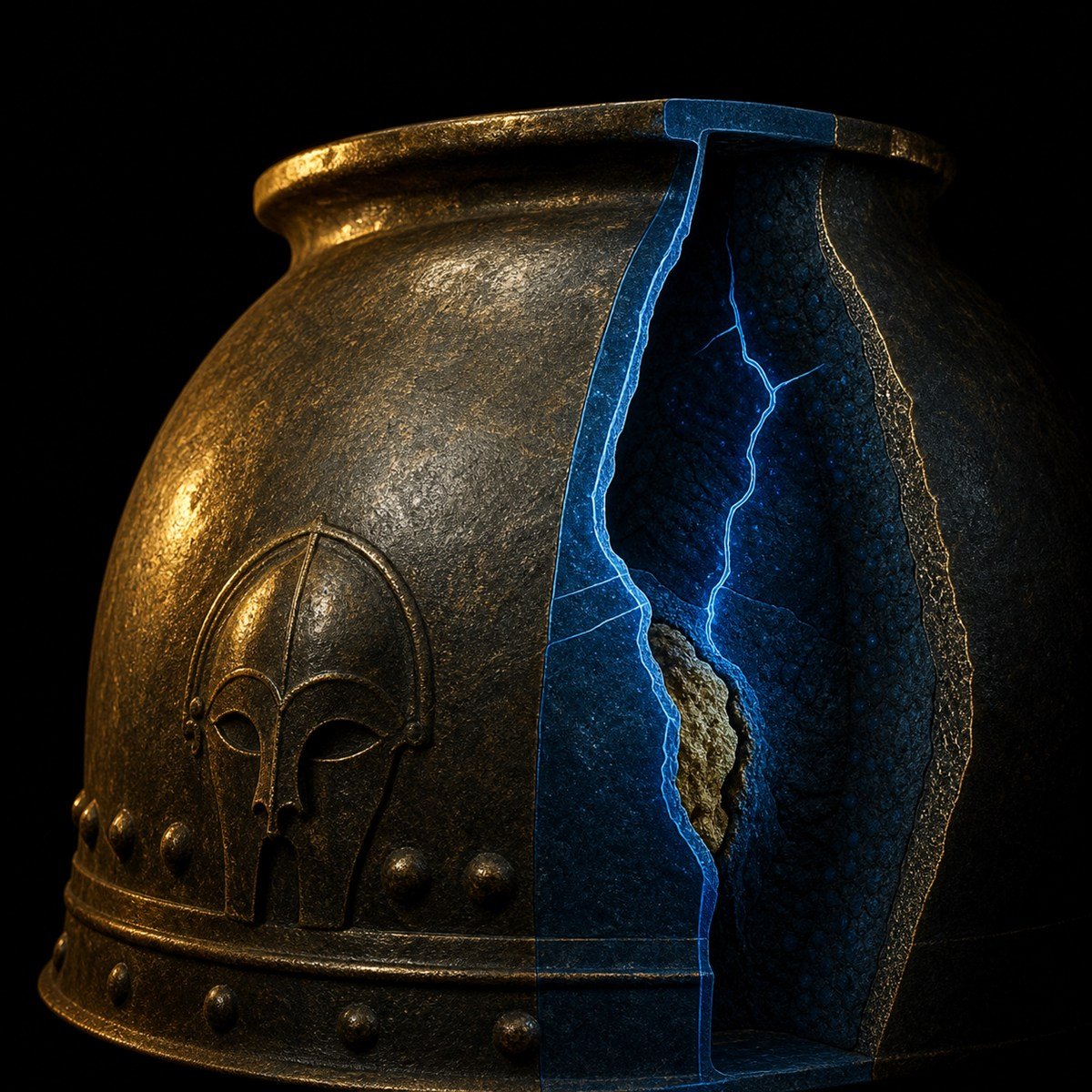
The owner's main problem is not when damage is obvious. It is when the object looks stable, the budget has already been agreed, and work reveals that the surface is being held together by old adhesive, internal corrosion or a few thin areas of mineralized metal.
Why a Good Photograph Is Not Enough
Modern photography can show patina colour, overall silhouette, major losses and some traces of previous intervention. But it turns a three-dimensional object into a flat image. We cannot feel its mass, see how loads are distributed, test fragment movement or inspect a closed interior cavity. Even a series of images from different angles remains preliminary evidence.
Objects with dark, even surfaces are especially deceptive. Contrast lighting can make them appear complete and coherent while small cracks disappear into shadow. Conversely, a rough green surface may look catastrophic even though the underlying structure is reasonably sound. Remote assessment can therefore answer ‘what may be happening’, but it cannot replace physical diagnosis.
Four Groups of Hidden Problems
A Crack Does Not Exist Separately from Load
The same line on a vessel, blade or helmet can represent very different risks. On a thin helmet wall, a crack may open under the object's own weight and dome deformation. On a vessel, the dangerous zone may be near a handle or rim. On a long weapon, slight misalignment can redistribute load into old joins. It is therefore not enough to mark a crack with an arrow; the function of that area must be understood.
An Old Restoration Can Look Convincing
Neat toning may conceal a thick layer of mastic, automotive filler or rigid adhesive. While the object remains still, the join can appear reliable. During transport, materials with different stiffness and thermal expansion work against one another. A thin original edge may then carry load from a much more massive insert and fail first.
This does not mean every previous restoration should be dismantled. Dismantling is itself an intervention and can cost the object original surface. Diagnosis must establish which areas are stable, which need local correction and which make the entire structure unsafe.
What Is Checked During Physical Inspection
Inspection begins without active intervention. The object is viewed in directional and diffuse light, from multiple angles and, where possible, under magnification. Colour, texture, edge thickness, contamination and the boundaries of old fills are compared. The specialist asks whether a visible line follows the logic of the construction or represents a later insert.
- overall geometry and deformation;
- condition of fragment edges and join zones;
- local mobility without forced flexing;
- powdery corrosion products and fresh colour changes;
- old adhesives, mastics, solders and mechanical fixings;
- internal cavities and hard-to-access areas;
- points that will carry load after assembly or mounting.
Additional investigations can be useful, but only when selected to answer a specific question. Compositional analysis does not automatically tell us how strong a wall is. Radiography can reveal structure and hidden elements, but it also requires interpretation. No instrument replaces the question: what exactly are we trying to confirm, and how will the result change the treatment plan?
How a Hidden Defect Changes the Decision
After inspection, the original plan may become smaller rather than larger. If an attractive surface is stable, local reinforcement and a proper storage support may be enough. If soldering would require dangerous heating of a mineralized area, internal reinforcement may be chosen instead. If an old insert is stable and removing it would create new losses, retaining it and calmly integrating visible boundaries may be the better decision.
In other cases the scope increases. Joining two large fragments may be impossible to do safely until deformation is corrected or temporary support is built. The owner should know this before any irreversible action. After physical diagnosis, the updated limits are agreed: necessary stabilization, desirable reconstruction and actions that will deliberately not be carried out.
The Owner's Concern: Budget Uncertainty
The concern is understandable: the object is sent away, work begins, and the cost seems to rise with every new discovery. Unknowns cannot be eliminated entirely, but they can be managed. A preliminary estimate must be clearly described as preliminary. After the object arrives, its condition is recorded and the plan is then confirmed or corrected. No additional reconstruction should become automatic merely because a new defect has been found.
A practical way to structure work is by levels. Level one covers what is necessary for safe handling. Level two restores legibility of form. Level three addresses visual integration. The owner can see which actions concern preservation and which concern chosen presentation. This reduces the risk of an aesthetic goal quietly replacing a conservation need.
What the Client Receives
The result of diagnosis is not a certificate of authenticity and not a promise of future auction value. It is a working decision about the object's actual condition. The client receives a clear description of observed problems, the agreed intervention limit, an updated indication of time and cost after inspection, and documentation of the work performed.
If the discovered risk requires another specialist or another form of examination, that is also a valid result. Sometimes the correct next step is laboratory consultation, a custom support, improved storage conditions or a decision not to intervene actively. The value of the work lies not in maximizing the number of operations but in reducing the risk of irreversible error.
Which Photographs to Prepare Before Contact
For a useful preliminary discussion, do not send only attractive frontal images. Include overall views front and back, both profiles, top and bottom, interior surfaces, a scale beside the object, and separate macro photographs of every crack, powdery corrosion area and old join. Change the light: soft light shows colour, side light reveals relief and deformation.
Do not clean the surface specifically for photography, press on cracks or try to dismantle an unstable join. If a fragment is already detached, photograph it separately and near its likely position without forcing it into place. Information about old restoration, storage and changes over recent months can be more useful than another dramatic angle.
Three Typical Situations from Practice
A Helmet Looks Complete but Is Losing Its Shape
The owner sees an attractive silhouette and assumes the task is limited to cleaning and local retouching. Side lighting reveals that the dome is supported not by its own structure but by an old internal insert. Several fragment edges barely meet and the load passes through a thick layer of rigid fill. Removing it immediately could cause the geometry to collapse. Leaving it unchecked could allow transport to open old cracks.
The solution is staged: first preserve the existing geometry temporarily, then determine which old areas are actually dangerous, and only then choose a support method. In one case partial retention of the old structure is justified; in another, local dismantling and new internal reinforcement. The criterion is not the age of the restoration but its effect on original metal.
A Vessel Is Stable on the Table but Unsafe to Lift
A thin-walled vessel may stand unchanged for years. The problem appears when it is lifted by the rim or handle. An old seam lies in the zone that suddenly carries the full weight of the object. In a photograph, the seam can look like an ordinary patina line; the weakness becomes evident only when the construction and handling method are assessed.
In such a case, restoration does not necessarily need to change the appearance. The main work may be to create a safe support, change the lifting method and locally reinforce the loaded area. The client receives not a dramatic ‘before and after’ but an object that can be stored, shown and transferred more safely. It is less spectacular but professionally more important.
A Blade Looks Straight in a Photograph but Is Built from Areas of Different Stiffness
A frontal photograph of a long object can hide slight twisting and changes in thickness. An old reconstruction may be stiffer than the original, so even a small bend transfers stress to the boundary of the insert. Simply trying to ‘straighten’ the blade can cause new damage. The first task is to understand where metal survives, where later material carries load and where the structure is already close to its limit.
The correct decision may be to preserve a small deformation. A historical object does not have to match the geometry of a new replica. If the pursuit of a perfectly straight line threatens surviving original surface, visual neatness should give way to preservation.
Questions an Owner Is Entitled to Ask Before Work Begins
Is the Estimate from Photographs Final?
No. Images can indicate the likely nature of the task, show which additional views are needed and help decide whether transport makes sense. The final plan is established after physical inspection. If a specialist gives an absolutely precise price and guaranteed result without seeing the interior, weight or structural behaviour, the owner should understand that a substantial part of the risk has not yet been accounted for.
What Happens if a New Defect Is Found?
Work should stop at a safe stage. The owner is shown the problem, its significance is explained, and options are offered: leave the area without further intervention, perform stabilization only, or agree an expanded scope. Discovery of a defect is not automatic permission to increase the work.
Can Hidden Risks Be Eliminated Completely?
No. Even analytical methods cannot provide absolute certainty in heterogeneous archaeological metal. The purpose of diagnosis is not to create an illusion of complete certainty, but to reduce uncertainty to a level at which a decision is justified. Residual risks should be stated clearly and taken into account in storage, transport and display.
Must Every Trace of Old Restoration Be Removed?
Not necessarily. Some old interventions are visually crude but structurally stable. Others look neat yet create dangerous loads. Complete dismantling can damage original edges and increase cost without equivalent benefit. Each area is therefore assessed on its own rather than judged simply by the age or material of the old restoration.
Is Laboratory Analysis Always Required?
No. Investigation is justified when the result can change the decision. Where the question concerns alloy composition, internal reinforcement, hidden soldering or metal distribution, an external specialist and suitable method may be useful. Analysis should not become a decorative line in a report. The question comes first; the instrument is chosen afterwards.
Can the Join Be Promised to Become Invisible?
Calm visual integration can be a legitimate aim, but absolute invisibility depends on edge condition, patina, lighting and the acceptable amount of reconstruction. The honest objective is to prevent the intervention from becoming the main visual subject while retaining the ability to explain where and why it was carried out.
How Can I Know the Object Is Safe to Transport?
From photographs, this can only be estimated. Mobile fragments, projecting parts, weak edges, mass and support points must be considered. Temporary stabilization or custom packing may be needed before transport. Insurance can compensate financial loss, but it cannot restore lost historical surface, so prevention matters more than formal coverage.
Which Comes First: Stabilization or Appearance?
If deterioration is active or the structure is unstable, preservation comes first. Visual integration only makes sense on a stable basis. Otherwise, an attractive result conceals a continuing problem and complicates later intervention.
Red Flags That Should Not Wait
Seek urgent advice if fresh pale-green powder appears, a fragment changes position, filler falls from an old seam, movement produces a sound inside a cavity, or particles from the surface remain in the packing. Do not clean further or test the object by pressing it. Place it in a stable position, limit movement and document the changes with photographs.
Another type of risk develops more slowly: storage near a window, heater, damp wall or in a closed display case with an unstable microclimate. The object may look unchanged for months while repeated environmental fluctuations gradually affect weak zones. Storage conditions are therefore part of diagnosis, not a minor domestic detail.
What a Reasonable Work Plan Looks Like
A good plan does not need to be long. It should separate observations, interpretations and proposed actions. ‘An old rigid fill is visible on the interior’ is an observation. ‘It may transfer load into a thin original edge’ is a professional interpretation. ‘A small control area will be opened locally and the next step agreed after inspection’ is the plan. This separation lets the owner understand what is known, what is inferred and what remains undecided.
The plan should also define the intervention limit: which zones will not be dismantled, which losses will not be filled, and what level of visual integration is expected. This is especially important for objects being prepared for sale. Presentability should not become concealment of intervention, and documentation should not become a grand certificate claiming more than the specialist actually established.
Conclusion: Understand First, Then Intervene
Hidden damage is not a reason to fear every ancient object. It is a reason to reject premature certainty. Good diagnosis turns uncertainty into a manageable list of questions: what is holding, what is deteriorating, where loads travel, which action is acceptable and where the correct stopping point lies.
That is why the final plan is not based on one image. Photographs open the discussion. Physical inspection defines the boundaries. An agreed scope protects both the object and the owner from decisions that cannot be reversed.
Practical Scenarios of Hidden Risk
These scenarios explain the logic, but a final decision is possible only after examining the specific object.
1. A Crack beneath Dense Patina
Situation.Only a fine line is visible outside, but side lighting changes the relief.
Decision.Do not load the area; inspect the interior and design support before cleaning.
Why.A dense surface can conceal loss of metallic continuity.
2. A Helmet Held Together by an Old Insert
Situation.The form looks complete, but original fragments barely touch.
Decision.Preserve the geometry temporarily, then assess the old structure section by section.
Why.Immediate dismantling may destroy the only surviving form.
3. A Loose Fragment inside a Cavity
Situation.A sound is heard inside the vessel during careful movement.
Decision.Stop moving the object and determine the fragment's position without shaking.
Why.An invisible loose element can strike thin walls during transport.
4. Adhesive Looks Intact but Has Lost Strength
Situation.The seam looks neat, but dust and slight displacement appear around it.
Decision.Provide support, inspect the join and agree a local replacement if needed.
Why.Visual neatness does not reveal material ageing or load distribution.
5. Hidden Solder near a Decorative Element
Situation.Only a colour transition is visible outside; inside is a rigid metal seam.
Decision.Assess the dissimilar materials and do not heat the area before understanding the construction.
Why.Reheating can alter patina and open a crack next to the soldered area.
6. A Mineralized Edge beneath Mastic
Situation.The fill appears strong, but the original edge survives only as a thin layer.
Decision.Do not remove all the mastic; open a small control area and select a supportive approach.
Why.Later material can both conceal a problem and hold a weak original edge together.
7. Twisting in a Long Blade
Situation.The frontal photograph shows a straight line, while the profile reveals torsional deformation.
Decision.Map stiffness and avoid force-straightening without support.
Why.Stress will concentrate at the boundary of an old insert or thin metal.
8. A Crack at the Base of a Handle
Situation.The vessel is stable at rest, but lifting transfers its full weight into the damaged area.
Decision.Change the handling method and create a base so the object need not be lifted by the handle.
Why.The hidden risk appears not at rest but during use.
9. Internal Corrosion beneath a Coating
Situation.The outer coating looks intact but is locally raised and changing colour.
Decision.Do not add a new layer; determine what is happening beneath the coating.
Why.Cosmetic continuity can trap moisture and conceal fresh corrosion products.
10. Traces of Modern Grinding
Situation.Catalogue lighting smooths the surface, while macro photographs reveal parallel scratches.
Decision.Separate later mechanical treatment from historical traces and do not try to even adjacent areas.
Why.Further grinding would increase loss without restoring the original surface.
11. Different Fragments Unified by One Retouching Layer
Situation.Colour makes the assembly look coherent, but joints and thicknesses do not correspond.
Decision.Check structural logic before further visual integration.
Why.Uniform patina can create a visual proof of connection that does not actually exist.
12. Moisture inside Packing
Situation.The box is dry outside, but the object was sealed before its temperature equalized.
Decision.Allow the system to acclimatize safely according to agreed instructions and check the environment.
Why.Condensation can form inside without being visible on the outside of the packing.
13. A Weak Edge beneath a Decorative Mount
Situation.The mount looks strong, but its weight is carried by a mineralized wall.
Decision.Redistribute the load with hidden support and do not use the mount as a handle.
Why.Risk is determined by the load path, not by the size of the visible crack.
14. Change after Replacing a Mannequin
Situation.The new support looks better, but after a month the edge has opened slightly.
Decision.Return to safe support and reassess the contact points.
Why.Even soft material can be dangerous if pressure is applied to the wrong zone.
15. An Unexpected Cavity in a Thick Component
Situation.Weight and sound do not match the expected solid construction.
Decision.Before drilling or filling, use an appropriate examination method and define the question it must answer.
Why.The unknown internal structure may be a technological feature, an old repair or an area of deterioration.
Owner’s working roadmap: from the first question to the final result
1. Record the baseline condition
When working with hidden damage, the first document is not a formal certificate but a clear initial record. Photograph the overall view, interior, base and problem areas with a scale. It is especially important to document old internal inserts, cracks beneath patina, mobility, sound and unexpected weight. A date and consistent viewpoint allow real change to be distinguished from impressions created by light or memory.
Add dimensions, weight, known storage history and previous interventions. Do not improve the surface before photography: powder, dust, fragment position and traces of old adhesive may be diagnostically important. A good enquiry does not need to look attractive; it needs to help identify risk.
2. Define the objective
Describe what the object is being prepared for: storage, display, research, transfer to a new owner or sale. The same problem may have different acceptable solutions. For hidden damage, the common objective is to reduce uncertainty without turning diagnosis into additional damage. That is more precise than asking for the object to be ‘fully restored’.
The objective defines the treatment limit but does not override safety. If the desired appearance threatens original material, the conservator should propose a more restrained route. It is useful to separate essential actions from desired presentation in advance.
3. Do not create a new risk
Before consultation, avoid force testing, immediate dismantling and exact quotations based only on photographs. Do not test strength by pressing, do not force detached parts into place and do not carry the object by projecting elements. Even a small action can alter a crack boundary and remove original evidence.
If the situation appears urgent, the safest first step is stable positioning, minimal handling and photographs. Urgency means obtaining advice quickly, not applying an improvised treatment quickly.
4. Understand the limits of photographs
Images help establish the direction of discussion, but physical inspection reveals weight, stiffness, sound, mobility and internal materials. For hidden damage, internal construction, load path, materials used in old repairs and the behaviour of the object on its support are especially important. Without these data, an exact price and guaranteed result would be speculation.
A preliminary range is still useful because it helps determine whether transfer of the object is justified. After examination, however, the plan is confirmed or adjusted. This sequence is professional caution, not an attempt to change the agreement.
5. Separate observation from interpretation
‘A pale loose area is visible on the surface’ is an observation. ‘This is an active process of a particular type’ is an interpretation requiring context. With hidden damage, keeping these apart protects against confident claims based on a single sign and helps explain why additional data may be necessary.
The record should distinguish what is known, what is suspected and what action is proposed to test the assumption. The client can then see the logic of the decision and understand where uncertainty remains.
6. Choose the minimum sufficient action
Minimal intervention does not mean low quality. It means every action addresses a named problem and does not extend into safe areas. The priority is to preserve existing geometry until it is understood what actually holds it together. If support, local stabilization or observation can achieve the objective, extensive intervention does not become mandatory.
After each significant stage, the condition is reassessed. The ability to stop is more valuable than a promise of maximum transformation made in advance. This is how the risk of irreversible error is controlled.
7. Agree on alternatives
A good proposal contains several levels: the essential minimum, possible restoration of readability and optional visual integration. The benefit, limitations and consequences of declining each level are explained. The owner makes an informed choice rather than receiving a single all-or-nothing package.
If a hidden defect changes the task, work stops at a safe stage. The revised option, schedule and cost are agreed in writing. The presence of the object in the studio is not permission for unlimited additional work.
8. Calculate time and cost
The minimum treatment cost starts at €300 because even a local task includes intake, examination, preparation of a safe work area, materials, photographic documentation and a final record. A more complex project also accounts for the number of fragments, access, weak edges, temporary fixation, monitoring and packing.
Time depends on condition, not only on the number of operations. Monitoring and correct sequencing cannot simply be removed to meet a deadline. If a sale timetable conflicts with safety, the timetable should be reconsidered.
9. Prepare for storage
The result is preserved by its environment. Hidden damage requires a position that avoids pressure on weak zones and limits unnecessary movement. Average readings alone are not enough: fluctuations, contact materials, dust, sunlight, heating and handling from the display case also matter.
Recommendations must be realistic for the owner. A complex system that is not maintained is worse than a simple, understandable support and regular checks. Changes should be documented photographically rather than judged only from memory.
10. Plan the transfer
Packing begins with the load path: which areas can carry weight, what must not touch the container walls and how the object will be removed. Insurance can compensate financial loss, but it cannot restore original surface. Custom mechanical support therefore matters more than the impressive appearance of the box.
Transfer through partners in Brussels or London is possible by prior arrangement. The intake point, route, accompanying documents and unpacking procedure are defined for each project. Do not send an object without confirmation.
11. Prepare the object for the market without promises
In a commercial context, hidden damage requires honest explanation of uncertainty and written agreement before the scope expands. The studio is responsible for the agreed condition, but does not issue attribution, insurance valuation or guarantees of acceptance or price. Those decisions belong to the relevant experts, dealers and auction houses.
Published results from previous projects demonstrate experience but do not predict the outcome of a new lot. Honest information and a stable object create more trust than dramatic concealment.
12. Review the outcome
Before handover, compare the original task with the result: has the stated risk been addressed, was the agreed treatment limit respected, and are the intervention areas and recommendations clear? The final record should be concise but sufficient for a future owner or conservator.
A high-quality result with hidden damage is not the maximum amount of work. It is reducing uncertainty without turning diagnosis into additional damage. If the object requires continued observation, that is stated as part of the solution rather than concealed behind the word ‘ready’.