
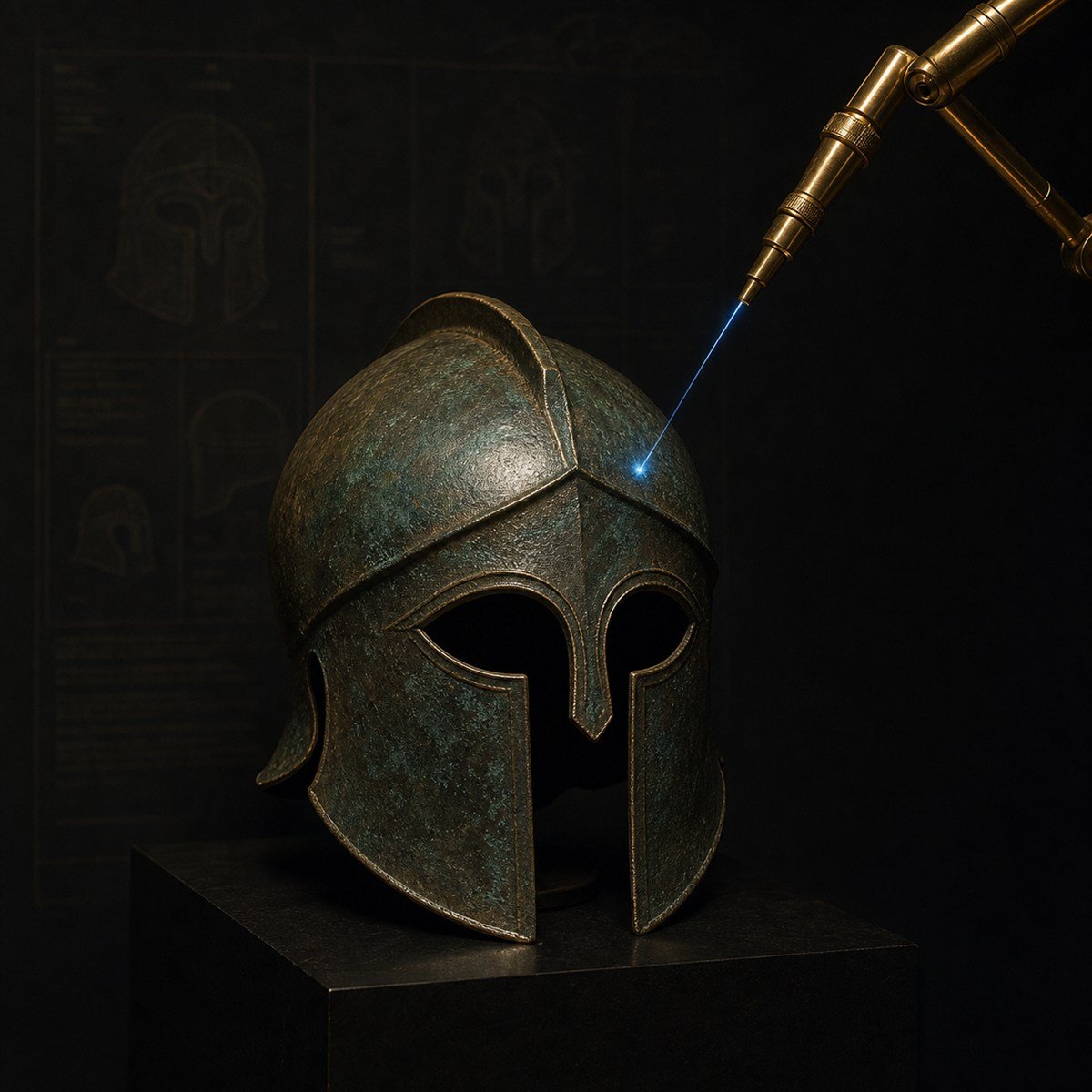
The Expert's First Look
An auction-house specialist looks at an object not as a collector, but as someone responsible for offering it for sale. The first question is: ‘Does this object have active problems that may become a problem for the buyer?’ Active bronze disease, unstable patina and obvious signs of crude restoration are all red flags.
Documentation as a Competitive Advantage
A lot accompanied by a complete documentation package — Intake Record, Insurance Condition Record and Restoration Report — is taken more seriously. It reduces risk for the auction house and gives the buyer greater transparency.
XRF Analysis as Additional Evidence
An XRF test confirms the metal composition and whether it is consistent with the stated period. For objects estimated from £10,000 upward, it has effectively become a standard supporting test. Arranging analysis through an accredited laboratory, for example Hebolabo in Belgium, is included in the studio's Full Pre-Auction Package.
Lot Acceptance Does Not Begin with a Beautiful Photograph
Before catalogue photography, an auction specialist asks whether the object is understandable, appropriate for the sale, capable of being described responsibly, and what questions a buyer may raise. Restoration affects legibility and stability, but it does not replace attribution, provenance or legal due diligence.
Preparation therefore begins with an honest condition map. Original material, later joins, fills and active risks must be distinguished. If those boundaries are hidden by cosmetics, the appeal of the first photograph quickly turns into distrust during inspection.
What an Auction House Assesses First
The first impression comes from silhouette, completeness, surface and the clarity of previous interventions. An unstable edge, fresh powdering, deformation or a crude seam makes handling and description more difficult. At the same time, an excessively uniform patina or signs of recent colouring also raise questions.
Each auction house has its own specialization, client base and internal process. The studio does not promise acceptance and does not speak on behalf of an auction house. Its task is to prepare the object so that its condition can be assessed professionally and presented safely.
Restoration, Conservation and Pre-Auction Preparation Are Not the Same Thing
Conservation reduces the risk of further deterioration. Reconstruction restores the legibility of form within agreed limits. Pre-auction preparation combines these tasks with the requirements of safe transfer, inspection and presentation. Sometimes a full cycle is justified; sometimes stabilization and a proper support are enough.
The central question is not ‘how can this be made more impressive?’ but ‘what action will reduce uncertainty for the next owner?’ In some cases, a preserved loss is more convincing than aggressive completion.
Why Old Restorations Become a Commercial Risk
Old adhesive, solder, mastic or an internal armature may look stable in a frontal photograph. During transport, the load changes and weakness can appear suddenly. Before dispatch, support points, projecting elements, fragment mobility and the method of removing the object from its packaging are assessed.
An old intervention should not be removed automatically. It may be holding the form together, while dismantling could damage original edges. The real risk is assessed first; only then is local correction or staged replacement of the structure proposed.
What Should Be Ready Before Approaching an Auction House
Accurate dimensions and weight, overall views from all sides, macro details of the surface and a concise record of interventions are useful. If a study has been carried out, the question, method and result should be stated without overextending the conclusion. A studio document is not a certificate of authenticity and does not replace the opinion of a specialist in attribution.
The auction house creates its own photographs in its own style. The studio's service is therefore not ‘20–40 photos like Christie's’, but the preparation of a stable, legible object and the information needed for the specialists' subsequent work.
How to Choose the Level of Visual Integration
For a catalogue, the object should read as a coherent form, but an intervention does not need to disappear under professional inspection. An overly contrasting insert attracts too much attention; perfect camouflage can create a misleading impression. The degree of integration is discussed after stabilization and structural checking.
The object is assessed in diffuse light, side light and cooler light. This helps reveal whether a coating creates glare, a visual hollow or an unexpected colour break in future photographs.
Logistics as Part of Preparation
A valuable object may be technically stable yet poorly prepared for transport. A custom support should carry weight through safe areas, prevent contact with weak edges and allow the object to be removed without complex manipulation. Insurance covers financial risk, but it cannot restore lost historical surface.
After a preliminary assessment, transfer through partners in Brussels or London can be arranged. Route, packing, documents and customs formalities are discussed before dispatch; no object is handed over without confirmation.
What Can Reduce Confidence in a Lot
Fresh powdery corrosion, an unclear reconstruction boundary, colour mismatch between interior and exterior, mobile elements, a strong smell from a new coating and unsupported promises are all red flags. Not every one of them means rejection, but every one requires an explanation.
Concealing a problem is almost always worse than the problem itself. A short, precise record and a clear intervention limit allow a specialist to separate observed fact from interpretation.
How the Agreed Scope Is Built
Level one is necessary stabilization. Level two is structural legibility and support. Level three is visual integration. Level four is preparation of information and safe transfer. The client sees the cost of each level and can make a decision without the scope expanding automatically.
If a new defect appears after inspection, work stops at a safe stage. Any new scope is agreed in writing. This protects both the object and the owner's commercial plan.
Timing Before a Sale
It is risky to begin complex stabilization immediately before a deadline. Time is needed for observation, possible correction and packing. The less stable the object, the less professional it is to promise an accelerated result.
A preliminary schedule is built around condition, not around the catalogue date. Sometimes it is more sensible to postpone submission to the next sale than to hand over an impressive but insufficiently tested object.
Cost of Preparation
The minimum cost of work starts at €300. Even a small task requires intake, inspection, safe preparation, material selection, photographic documentation and a final record. A larger project is priced after physical inspection and agreement on the intervention limit.
The cost of preparation is not the same as the future increase at auction. It reflects the scope and risk of the specific work. Commercial outcome also depends on authenticity, rarity, provenance, demand, estimate and the auction house's strategy.
Conclusion: Readiness Matters More Than Decorative Effect
A well-prepared object is stable, legible, safe to handle and accompanied by clear information. It does not need to look new. Its surface should withstand close examination, and its structure should withstand the agreed route to handover.
Start with overall photographs, the interior and problem areas. A preliminary assessment will determine whether a physical inspection makes sense and what timeframe is realistic.
Practical Situations Before Submitting a Lot
These scenarios demonstrate the decision-making principle. No specific auction or sales outcome is guaranteed.
1. A Rare Helmet with Active Corrosion
Initial situation.The form is legible and the provenance is known, but fresh powder appears on the interior shortly before the submission deadline.
Risk and decision.Catalogue appearance does not justify concealment. Stabilization, monitoring and an honest schedule are required; sometimes the better decision is to postpone the sale.
Practical conclusion.Urgency increases the priority of consultation, but does not eliminate necessary stages.
2. A Fragmentary Vessel with a Good Surface
Initial situation.The patina is convincing, but the silhouette is fragmented and the object cannot be positioned safely.
Risk and decision.Internal support and a justified recovery of geometry may improve legibility without complete filling.
Practical conclusion.The auction house receives a clear description of the structure and the boundaries of new material.
3. A Sword after an Old Crude Assembly
Initial situation.The blade appears straight, but the joints are rigid and transfer load to weak fragments.
Risk and decision.Complete dismantling is risky; the real structure is assessed first, followed by local correction or a new reinforcement system.
Practical conclusion.An attractive silhouette is not readiness if transport could open the joint.
4. An Object with a Striking Later Patina
Initial situation.The colour is attractive, but it conceals dissimilar inserts and makes the original surface difficult to read.
Risk and decision.Total removal could cause damage, while leaving it unexplained could reduce confidence.
Practical conclusion.A local assessment is carried out, the later layer is documented, and only areas affecting condition and description are corrected.
5. A Lot without Accurate Dimensions or Weight
Initial situation.Only a few dealer photographs and an approximate description are available.
Risk and decision.A restoration project cannot be built on incomplete information; auction preparation starts with basic documentation.
Practical conclusion.Dimensions, weight, views from all sides and known history are required before a presentation strategy.
6. A Helmet on an Unsuitable Mannequin
Initial situation.The object looks impressive, but the rim carries the weight and it is difficult to remove without touching the cheek pieces.
Risk and decision.The support becomes part of preservation and logistics; the decorative mannequin is replaced with a custom structure.
Practical conclusion.A good mount makes inspection and photography easier without implying a false provenance or historical arrangement.
7. A Vessel with an Unknown Coating Odour
Initial situation.The surface has recently been treated and has a strong smell, although it looks calm.
Risk and decision.An unknown composition raises compatibility questions and can complicate acceptance.
Practical conclusion.The treatment history should be established, the coating allowed to stabilize and an honest record prepared.
8. A Blade with Slight Deformation
Initial situation.The owner requests a perfectly straight line before the sale.
Risk and decision.Straightening can transfer stress to mineralized areas and old inserts.
Practical conclusion.A minor historical deformation is better than a new crack; safety is more important than geometric perfection.
9. An Object with Unconfirmed Attribution
Initial situation.Restoration is expected to serve as proof of a rare type.
Risk and decision.Condition treatment does not confirm origin, date or authorship.
Practical conclusion.Attribution is kept separate from conservation; studio wording remains within what can actually be observed.
10. A Group of Armour Components
Initial situation.Each plate is stable on its own, but the proposed assembly is uncertain.
Risk and decision.A striking complete composition may create an invented structure.
Practical conclusion.Reliable connections are preserved and shown; disputed elements are placed on neutral support.
11. A Lot with a Short Transport Deadline
Initial situation.Only a few days remain before handover and the packing is generic.
Risk and decision.Even a stable object can be damaged by incorrect restraint.
Practical conclusion.The load path and method of removal are designed first, then the route through Brussels or London is agreed.
12. An Object after High-Quality Stabilization
Initial situation.The surface is calm, but the owner wants a more dramatic transformation.
Risk and decision.Additional cleaning and retouching may reduce historical value without providing commercial benefit.
Practical conclusion.Knowing when to stop is part of pre-auction strategy, not a refusal to deliver quality.
13. An Expensive Object in Cheap Packing
Initial situation.The insured value is high, but the object moves freely inside the box.
Risk and decision.Insurance cannot restore a surface and does not replace a custom support.
Practical conclusion.The logistics budget should be compared not with the price of cardboard, but with the irreversibility of possible loss.
14. The Auction House Requests Additional Information
Initial situation.Questions about seams and inserts arise after the initial review.
Risk and decision.A short, clear record is more useful than an impressive certificate issued without the relevant authority.
Practical conclusion.Before-and-after photographs and a list of interventions are provided without crossing into attribution.
15. The Object Does Not Fit the Chosen House's Profile
Initial situation.The condition has been prepared well, but the venue declines the lot.
Risk and decision.The reason may be commercial, thematic or legal rather than related to restoration.
Practical conclusion.A refusal does not prove poor conservation work; venue strategy should be discussed separately with the appropriate market specialist.
Owner’s working roadmap: from the first question to the final result
1. Record the baseline condition
In pre-auction preparation, the first document is not a formal certificate but a clear initial record. Photograph the overall view, interior, base and problem areas with a scale. It is especially important to note unstable edges, unclear seams, unsuitable support and missing condition information. A date and consistent viewpoint make it possible to distinguish real change from impressions created by lighting or memory.
Add dimensions, weight, known storage history and previous interventions. Do not improve the surface before photography: powder, dust, fragment position and traces of old adhesive may be diagnostically important. A good enquiry does not need to look attractive; it needs to help identify risk.
2. Define the objective
Describe what the object is being prepared for: storage, display, study, transfer to a new owner or sale. The same problem can have different acceptable solutions. For auction preparation, the common goal remains to make the object stable, legible and professionally explainable. That is more precise than asking to ‘restore it completely’.
The objective defines the treatment limit but does not override safety. If the desired appearance threatens original material, the conservator should propose a more restrained route. It is useful to separate essential actions from desired presentation in advance.
3. Do not create a new risk
Before consultation, avoid cosmetic treatment in place of stabilization, imitation of catalogue styling and promises of lot acceptance. Do not test strength by pressing, do not force a detached element into place, and do not carry the object by projecting parts. Even a small action can alter a crack boundary and deprive the specialist of original evidence.
If the situation appears urgent, the safest first step is stable positioning, minimal handling and photographs. Urgency means obtaining advice quickly, not applying an improvised treatment quickly.
4. Understand the limits of photographs
Images help determine the direction of the discussion, but physical inspection reveals weight, stiffness, sound, mobility and internal materials. For auction preparation, it is especially important to assess condition, weight, dimensions, load points, old repairs and the real time available before handover. Without these data, an exact price and guaranteed result would be speculation.
A preliminary range is still useful because it helps determine whether transfer of the object is justified. After examination, however, the plan is confirmed or adjusted. This sequence is professional caution, not an attempt to change the agreement.
5. Separate observation from interpretation
‘A pale powdery area is visible on the surface’ is an observation. ‘This is an active process of a particular type’ is an interpretation that requires context. In auction preparation, keeping these apart protects against confident claims based on a single sign and helps explain why additional data are sometimes necessary.
The record should distinguish what is known, what is suspected and what action is proposed to test the assumption. The client can then see the logic of the decision and understand where uncertainty remains.
6. Choose the minimum sufficient action
Minimal intervention does not mean low quality. It means that each action addresses a named problem and does not extend into safe areas. The priority is to preserve original surface, a verifiable structure and an honest intervention history. If the result can be achieved through support, local stabilization or observation, extensive treatment does not become mandatory.
After each significant stage, the condition is reassessed. The ability to stop is more valuable than a promise of maximum transformation made in advance. This is how the risk of irreversible error is controlled.
7. Agree on alternatives
A good proposal contains several levels: the essential minimum, possible restoration of readability and optional visual integration. The benefit, limitations and consequences of declining each level are explained. The owner makes an informed choice rather than receiving a single all-or-nothing package.
If a hidden defect changes the task, work stops at a safe stage. The revised option, schedule and cost are agreed in writing. The presence of the object in the studio is not permission for unlimited additional work.
8. Calculate time and cost
The minimum treatment cost starts at €300 because even a local task includes intake, examination, preparation of a safe work area, materials, photographic documentation and a final record. A more complex project also accounts for the number of fragments, access, weak edges, temporary fixation, monitoring and packing.
Time depends on condition, not only on the number of operations. Monitoring and correct sequencing cannot simply be removed to meet a deadline. If a sale timetable conflicts with safety, the timetable should be reconsidered.
9. Prepare for storage
The result of treatment is preserved by its environment. For auction preparation, a safe support, understandable packing and an agreed route through partners are required. What matters is not only average readings, but also fluctuations, contact materials, dust, sunlight, heating and the way the object is lifted from a display case.
Recommendations must be realistic for the owner. A complex system that is not maintained is worse than a simple, understandable support and regular checks. Changes should be documented photographically rather than judged only from memory.
10. Plan the transfer
Packing begins with the load path: which areas can carry weight, what must not touch the container walls and how the object will be removed. Insurance can compensate financial loss, but it cannot restore original surface. Custom mechanical support therefore matters more than the impressive appearance of the box.
Transfer through partners in Brussels or London is possible by prior arrangement. The intake point, route, accompanying documents and unpacking procedure are defined for each project. Do not send an object without confirmation.
11. Prepare the object for the market without promises
In a commercial context, auction preparation requires readiness for inspection, independent photography and description by the auction house. The studio is responsible for the agreed condition, but it does not issue attribution, insurance valuation or guarantees of acceptance or price. Those decisions belong to the relevant experts, dealers and auction houses.
Published results from previous projects demonstrate experience but do not predict the outcome of a new lot. Honest information and a stable object create more trust than dramatic concealment.
12. Review the outcome
Before handover, compare the original task with the result: has the stated risk been addressed, was the agreed treatment limit respected, and are the intervention areas and recommendations clear? The final record should be concise but sufficient for a future owner or conservator.
A high-quality result in auction preparation is not the maximum amount of work. It is making the object stable, legible and professionally explainable. If the object requires further observation, that is stated as part of the solution rather than concealed behind the word ‘ready’.
Questions before approving treatment
Can a decision be made without physically transferring the object?
For pre-auction preparation, photographs open the discussion and help establish urgency, but the final plan requires physical inspection. From a distance, weight, stiffness, mobility, internal repairs and the behaviour of a weak area cannot be assessed reliably.
A useful preliminary assessment states these limitations explicitly. It identifies which additional photographs are needed, whether transfer is justified and what range of treatment is likely, without presenting an assumption as a final diagnosis.
What evidence will be used?
The decision is based on condition, dimensions, weight, support, old repairs and the handover schedule. When necessary, a study is selected to answer a specific question. The mere existence of an analysis does not make a conclusion automatically correct and does not replace comparison with the structure and surface.
In the final record, observations are separated from interpretations. This allows the owner, dealer or next specialist to understand not only the conclusion but also how it was reached.
What does the studio explicitly not promise?
The studio does not promise authenticity, attribution, insurance value, auction acceptance, a specific sale price or absolute permanent stability. These matters are either outside the scope of conservation treatment or depend on future conditions and third-party decisions.
The professional commitment is narrower and more valuable: assess, carry out and document the work within the agreed limits, state residual risk and not expand the scope without written approval.
Where is the treatment limit?
For pre-auction preparation, the intervention limit means refusing cosmetics that conceal risk or distort description. It is fixed before work begins and revised only when new information appears. An aesthetic preference does not override preservation of original material.
If an additional operation offers little benefit and clearly increases risk, the correct decision is to decline it. Stopping is part of the method, not unfinished work.
How is a successful result defined?
A practical criterion is readiness for safe inspection, independent photography and the auction house's decision. This is more verifiable than phrases such as ‘fully restored’ or ‘like new’. The result should match the owner's goal and remain understandable later.
Part of a successful outcome may lie beyond the surface itself: a safe support, clear handling procedure, stable environment and reference photographs. These measures often preserve an object longer than the most visible retouching.
What is included in the minimum cost?
The minimum treatment cost starts at €300. It includes the basic professional cycle: intake, examination, preparation of a safe workspace, material selection, photographic documentation and a final record. A small treatment area therefore does not mean that preparatory stages disappear.
A complex project is priced after examination and divided into the essential minimum and optional additions. The client can see what the cost covers and what the consequence of declining a particular stage would be.
How should the object be prepared for transfer?
First agree on the route and intake point. Partner locations in Brussels and London are used only after the project has been confirmed. Packing is designed around weak areas, weight and the method of removal, not selected solely by box size.
Detached fragments should be packed separately and labelled. Do not clean, glue or pressure-test the object before shipment. Insurance supplements, but does not replace, correct mechanical support.
What is the next step?
Prepare an overall view, interior, base, scale reference and macro photographs of problem areas. Add dimensions, known storage history, previous interventions and the purpose of the enquiry. Write in the language most convenient for you: written communication preserves details accurately.
An initial reply is usually provided within two working days. It will help clarify urgency, what additional information is needed and the safest route to physical examination.
Final Check Before Handover of the Lot
Before dispatch, the object's stability on its support, absence of mobile elements, clarity of unpacking instructions and consistency between the final record and the work actually performed are checked once again. The owner should know which areas remain sensitive and which actions must not be performed during inspection. Partner, carrier and recipient contacts are confirmed before movement begins.
Auction readiness is not a promise of sale. It is a condition in which the object can be transferred safely, examined closely, photographed independently and described without having to guess the nature of previous interventions. That kind of preparation supports confidence better than any attempt to imitate the catalogue style of a particular auction house.